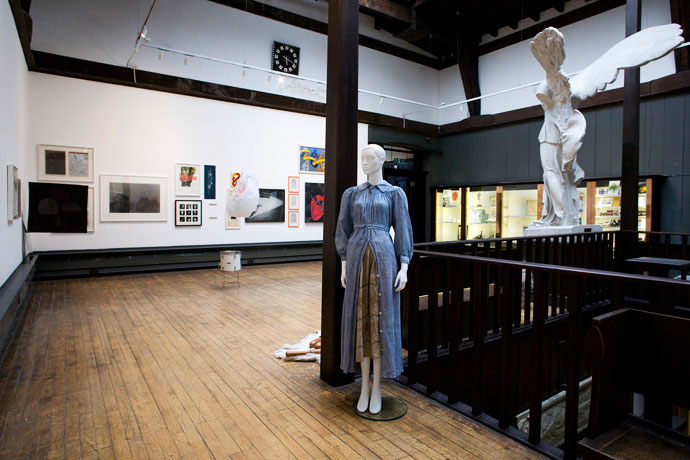
Studio 58: Women Artists in Glasgow Since WWII (2012)

ImageGen-1.ashx
Mackintosh Museum, Glasgow, 7th July – 30th September
2012

Curated by Sarah Lowndes

Studio 58: Women Artists in Glasgow since World War II was an exhibition and accompanying publication examining the period between World War II and the present day when women artists in Glasgow are at the forefront of the art scene in the city. The title of the exhibition comes from the studio located on the top floor of the Mackintosh Building which historically was the dedicated work space for women students.
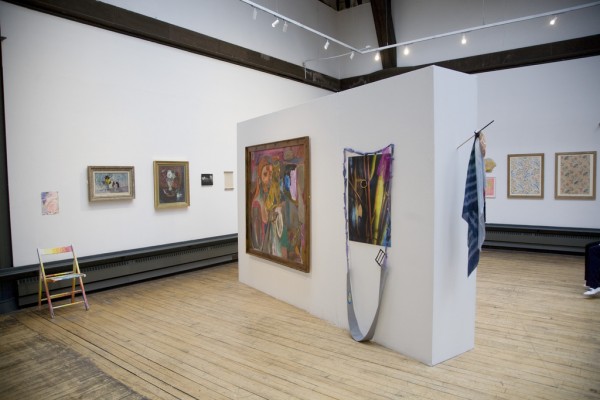
Studio 58 installation view (2012), featuring works by (L-R) Hayley Tompkins, Louise Armour, Carole Gibbons and Laura Aldridge.
Studio 58 installation view (2012), featuring works by (L-R) Hayley Tompkins, Louise Armour, Cathy Wilkes, Annette Heyer, Carole Gibbons, Laura Aldridge, Corin Sworn and Viola Paterson.

In recent years, a number of highly regarded women artists have emerged from the Glasgow art scene, including Turner Prize nominees Christine Borland, Cathy Wilkes and Karla Black.
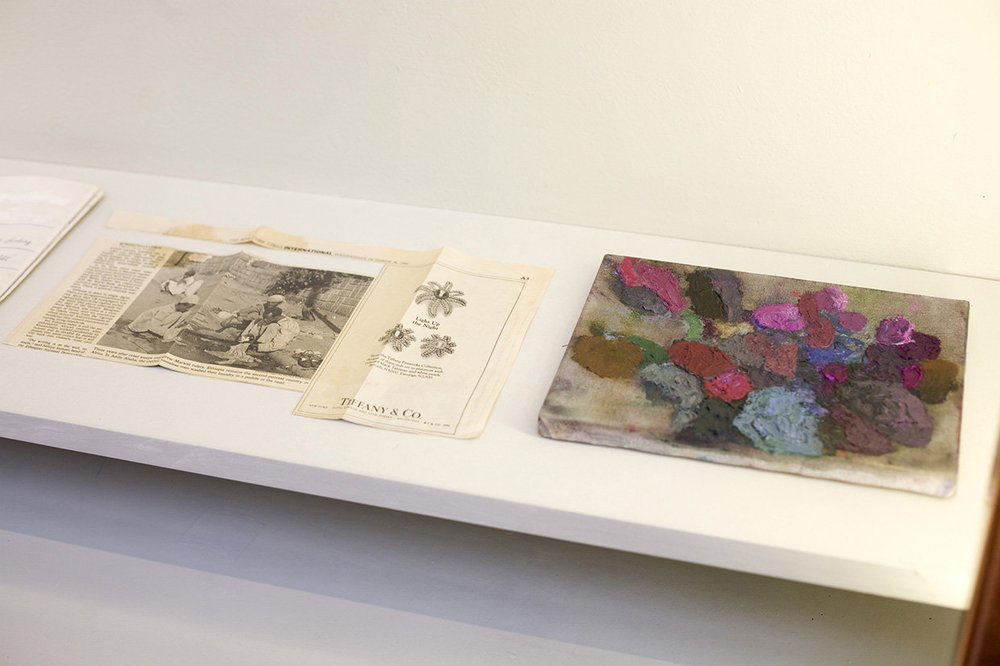
Cathy Wilkes, Untitled Drawings and paintings (2012), installation view, Studio 58 (2012)
Cathy Wilkes, Untitled drawings and paintings (2012), installation view, Studio 58 (2012)

Studio 58 contextualised the work of contemporary women artists in Glasgow through documenting and displaying the little known and under-represented lineage of women’s art in the city from 1939 onwards, within the frame of the city’s art school where all of the artists included in the exhibition either studied or taught.
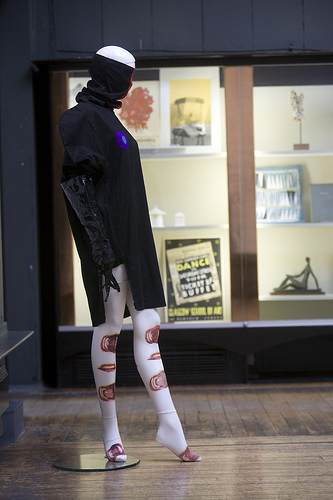
Adele Patrick, Self Defence garments (1986), Studio 58 (2012)

The most well known period, 1890 – 1930, has been documented in several publications and the recent exhibition ‘Glasgow Girls’ (2010), however the post-World War II period has not been subject to the same level of analysis. Studio 58 was organised around four thematic strands:  landscape/still life, body/self, printed matter and photography/film and will focus upon the work of over 50 artists active from the late 1930s onwards.  The 54 featured artists included Margaret Morris, Mary Armour, Ivy Proudfoot, and Kathleen Mann, as well as those that followed them including Joan Eardley, Margot Sandeman, Bet Low and Sam Ainsley and younger artists such as Cathy Wilkes, Claire Barclay, Victoria Morton, Hayley Tompkins and Karla Black.
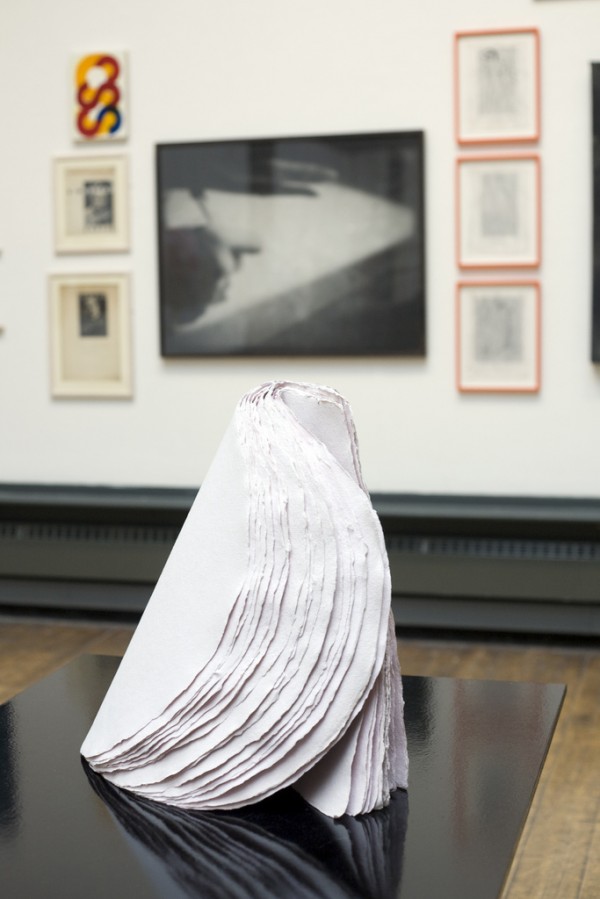
Studio 58 installation view featuring works by (L-R) Garcia Hunter, Christina McBride, Jacki Parry and Kate Davis.
Studio 58 installation view featuring works by (L-R) Sophie Mackfall, Garcia Hunter, Christina McBride, Jacki Parry and Kate Davis.

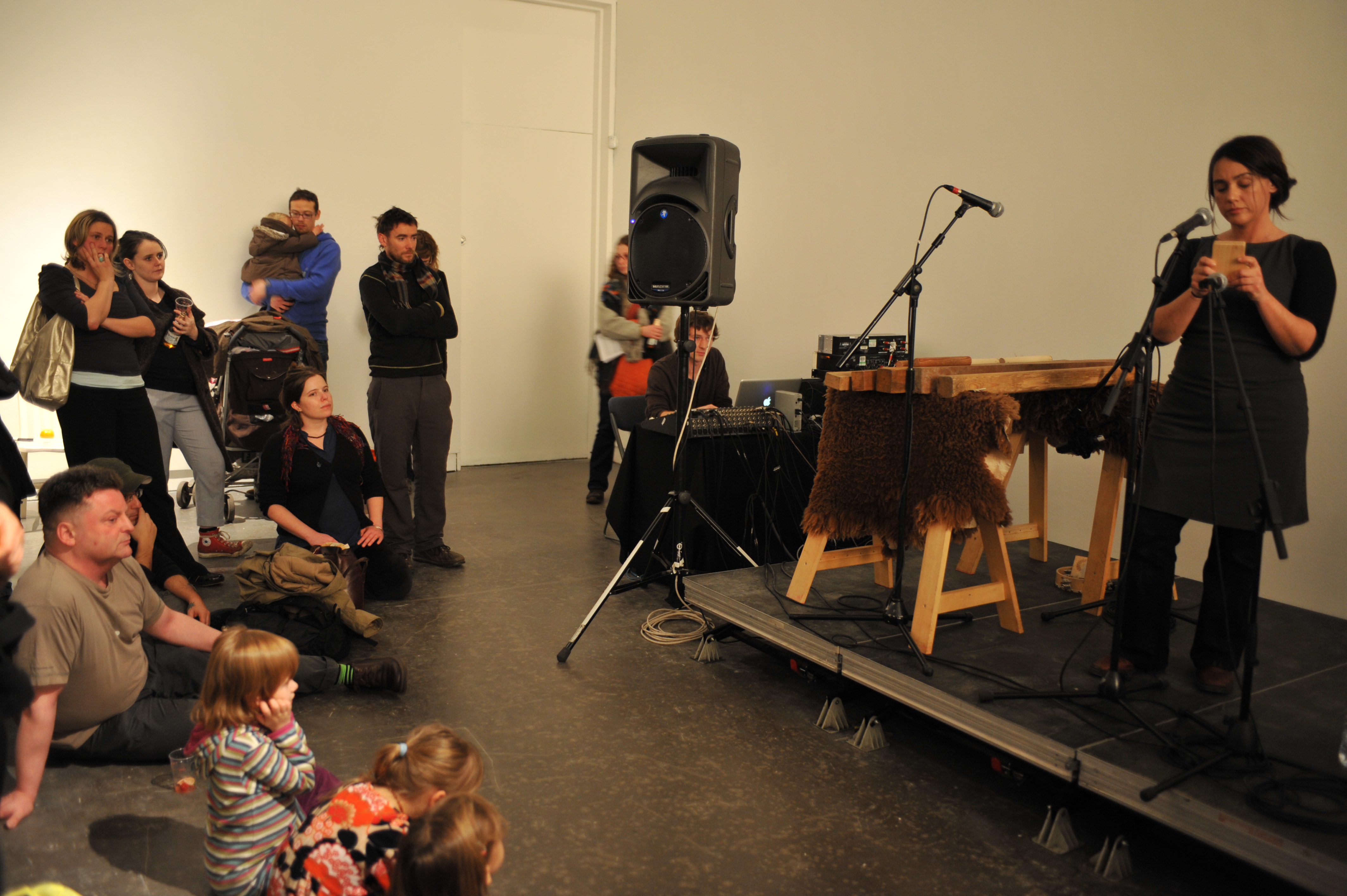
Studio 58 featured many seldom viewed works loaned from private collections and the collections of Glasgow Museums, The Hunterian Museum, The Glasgow School of Art Archives & Collections and Glasgow Women’s Library.  There was a symposium to accompany the exhibition, a screening event and a live performance on the opening night of the exhibition by Romany Dear.
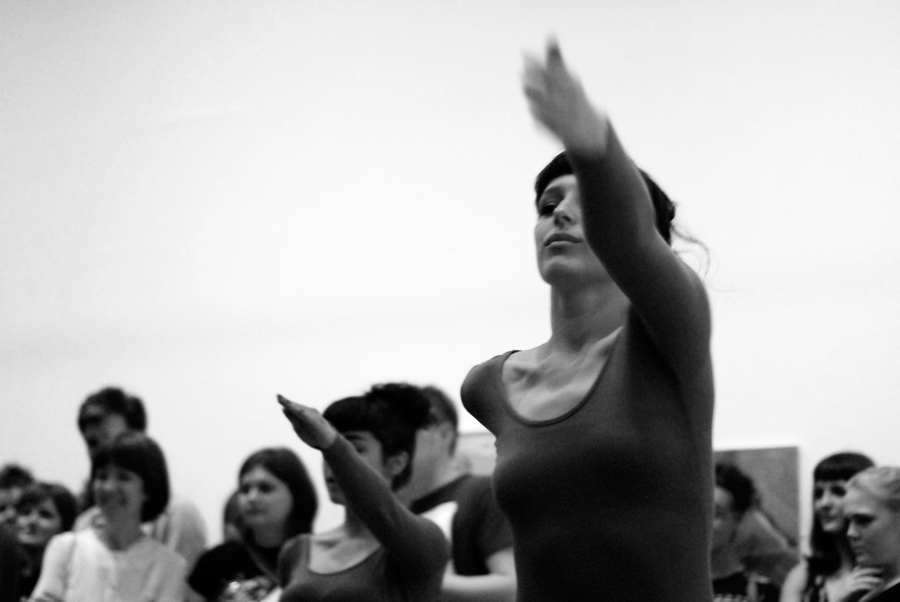
Romany Dear, March Your Legs Up and Down, this has the potential to become a very political exercise (2012), Studio 58 (2012)

The Studio 58 catalogue, edited by Sarah Lowndes, is available from the GSA shop and and Aye Aye books. Published by The Glasgow School of Art on the occasion of the exhibition Studio 58: Women Artists in Glasgow since World War II, designed by GSA graduates Sophie Dyer and Maeve Redmond it features contributions from the 54 artists in the exhibition and writer’s texts by Aleana Egan, Liz Lochhead, Sarah LowndesLouise Shelley and Joanne Tatham. The publication was supported by Glasgow Life, The Glasgow Society of Women Artists and the Research Development Fund at The Glasgow School of Art.  ISBN 978-0-9567646-1-4

Sarah Lowndes, ed., Studio 58 catalogue (2012)

Review

Kathleen Morgan, “Studio 58: the magic number”, The Herald, Saturday 30 June 2012

High up in the Glasgow School of Art is Studio 58.

It was once the domain of female art students with the stomach to succeed in a male-dominated institution – and bladders to match. As late as the 1950s, the students would have to dash during breaks from the studio to the only women’s toilet in the building.

Decades on, Dr Sarah Lowndes snuggles into one of Charles Rennie Mackintosh’s beautifully crafted cubby-holes to talk about curating a new exhibition, Studio 58: Women Artists In Glasgow Since World War Two. It features art by 54 women who made their names and carved reputations in Glasgow.

Nearby, 11 of the featured artists chat after having their photograph taken in the Mackintosh Library. It is a couple of days before their works are brought together, and the sense of excitement is palpable. For the past hour or so they have created a buzz that has echoed down the corridors and stairwells of the Mackintosh Building at the core of the art school.

Among those featured in Studio 58 are Joan Eardley, Hannah Frew Paterson, Carol Rhodes, Sam Ainsley, Christine Borland and rising star Romany Dear. Some are more widely known than others, but all are innovators who have left their mark as artists, educators or mentors.

“Until the 1950s, Studio 58 was a designated women’s studio,” explains Lowndes, who lectures at the art school. “Studio 58 is at the west end of the building and the only women’s toilet was at the east end, so the ‘hen run’ – a corridor – was the way women students would hurry to go to the loo during breaks.”

Lowndes, who wrote Social Sculpture: The Rise Of The Glasgow Art Scene, is passionate about her latest exhibition. Put crudely, the show is payback time for an array of female artists, many of whom never received the recognition they were due. The exhibits, gathered from private and public collections, have in some cases been collecting dust for decades.

“A lot of these kind of works haven’t been shown before, and that’s quite moving,” says Lowndes, 36, whose bright-green jeans and mop of wavy blonde hair belie the stereotype of an academic. “You go to Glasgow Museums and they unwrap this plaster head and it’s an Ivy Proudfoot piece, and it hasn’t really been shown before.”

It all began two years ago when Lowndes was asked to curate an exhibition for the Mackintosh Museum at the school of art. “I’d been working here for 10 years and had been in and out of this building all the time,” she says. “I felt it was such a specialist space, such a loaded space, that it just wouldn’t make sense to curate a show of minimalist sculpture or something. It had to respond to being in the very particular circumstances of the Mackintosh Museum. There was this history of the Glasgow Boys and the New Glasgow Boys, and I thought it would be good to redress that balance and have a show by women artists.”

Lowndes, who is married to the Turner Prize-winning artist Richard Wright, has her own theory as to why women artists have often received less acclaim than their male counterparts.

“Some people have questioned the need to have this kind of exhibition,” she says, “but in wider society, the median pay gap in the UK is one of the worst in Europe.” The gap between full-time men’s and women’s earnings was 9.1% in 2011, according to the Office for National Statistics.

“If you look at the art scene, that kind of inequality is replicated in things like the Turner Prize,” continues Lowndes. “Only four women have won it since it started in 1984. In the Tate Modern [in London], 83% of the works are by men.

“There is a kind of innate sexism and I suspect women operate a bit differently. Often, the things women do are invisible. Things like teaching other people, keeping together communities, making connections between friends and relatives, and taking care of people are not necessarily going to win you any prizes or coverage in newspapers, but the world can’t work without those things.”

The art school, perched on Garnethill close to Glasgow city centre, is the thread that links the exhibitors. Among the women meeting today is the acclaimed artist Carol Rhodes, 53, who teaches painting at the art school. Born in Edinburgh, Rhodes spent much of her childhood in Bengal before returning to Scotland during her teens and beginning art school in 1977. Her aerial landscapes take their influence from Indian miniatures, which have the effect of flattening out people and objects, giving them the same priority on the canvas.

Glasgow’s contemporary art scene is often associated these days with the Turner Prize-winners Wright, Douglas Gordon and Martin Boyce, along with nominees Christine Borland and Lucy Skaer. Rhodes has some concerns about the effect of this success on current students, who fail to look further afield for inspiration. “A lot of the students now look mostly at Glasgow artists and I think that’s fairly damaging,” she says. “They don’t look outwards. The Glasgow scene is so powerful, and for a student, it can be quite overwhelming.”

Rhodes describes being a painter as “a bit lonely at times”. She recently opened a gallery, 42 Carlton Place, in the Gorbals, at the flat she shares with her partner, the artist Merlin James.

Adele Patrick once shared the same concerns as Rhodes about a dominant art movement threatening to obscure other innovative work. She began studying a BA in embroidered and woven textiles at the school just as the New Glasgow Boys, including Peter Howson, Ken Currie and Steven Campbell, emerged.

Patrick, 50, describes a post-punk era when conventions were being challenged in society – and in the art world.

“The New Glasgow Boys were starting up and there was a lot of critical attention. A lot of women were saying, ‘Hold on, there’s another type of aesthetic and sensibility out here.'”

After graduating, Patrick co-founded the design company Graven Images with Janice Kirkpatrick and began teaching at the art school. Two decades ago, she helped launch the Glasgow Women’s Library as “a place and a space for women’s art, culture and writing”.

Patrick tells how she and her fellow art students drew inspiration from female artists such as Margaret Macdonald, the wife of Charles Rennie Mackintosh. This was, she says, before the Glasgow Girls, who flourished from the 1890s to around 1910, had been “excavated” from obscurity. “We grabbed on to these women for dear life,” she says. “We didn’t know very much about them but we knew they’d survived the art school.”

Like so many of her fellow students, Patrick was heavily influenced by the artist and lecturer Sam Ainsley. She describes Ainsley, who co-founded the master of fine art programme, as “striding through the art school with bright red lipstick and fabulous hair”. Patrick continues: “She was unequivocally a feminist figurehead. She was on the teaching staff, so seeing that woman around was really important.”

Ainsley’s influence echoes down the decades and the acclaimed artist’s screenprints are being exhibited in Studio 58.

Another name being talked about today is Hannah Frew Paterson. Unable to join her fellow exhibitors at the art school, the 81-year-old speaks to me at her home in Broomhill, Glasgow. An embroiderer whose work illuminates churches across Scotland – including St Margaret’s Chapel in Edinburgh Castle – she pushed the boundaries of a traditional art form until it squeaked.

Encouraged by her mentor and lecturer, Kath Whyte, Paterson went on to teach at the art school for 22 years. The walls of her home are decorated with the work of former students, and she points to a piece by Whyte, which will be shown in the exhibition. On the stair landing sits her own work, Motivator, also being exhibited. An embroidery work almost like a sculpture, it was inspired by the burned-out motor of a food mixer sent for repair.

Brought up in Chapelton, South Lanarkshire, Paterson is the daughter of a blacksmith and a grocery shop worker. Like so many of her generation, the young Paterson stepped aside to allow her brothers an education while she went out to work. “We weren’t very wealthy and my two brothers wanted to be architects, which was a long training,” she says. “It was never discussed – I just decided I should get on with it.” At 19, she began working as a designer for J&P Coats in Glasgow, but soon discovered a brave new world when the company sent her to the art school on day release.

“Initially I was trained as a diagram artist, showing people how to do the embroidery and writing instructions,” she explains in a clear, steady voice. “Then J&P Coats decided I would benefit from training in crochet design, and they sent me to the art school.”

There she was tutored by Whyte, who asked why she hadn’t applied to art school. “I decided overnight that’s what I wanted to do and told them at J&P Coats,” remembers Paterson. “The great thing was they encouraged me, and after I left and went as a student they gave me part-time work.”

Paterson describes art school during the 1960s as daunting, but also exhilarating, since there was a sea change in teaching methods. Her section of the year group became known as “the inventors’ club”, due to their experimental work under inspiring tutors such as Whyte.

A decade later, Whyte was to be bitterly disappointed when Paterson married and began teaching part time so she could bring up her three-year-old stepson. “She thought I was going to be dedicated like her and take over the department after she retired in 1974,” says Paterson, laughing affectionately. “She didn’t approve of my husband and son, but I loved her dearly. She was a wonderful woman.”

Paterson also felt the domestic pressures Lowndes refers to – and gladly embraced them for her stepson, John, and husband, Tom. She tells a story about working on Cardross Church’s giant embroidered panels. “I was spending weekends working doing the Cardross panels. They’re 12ft by 6ft and took three years to complete. I’ll never forget John coming in to the workroom one day and asking, ‘Mum, are you coming to the park this time?’ It broke my heart and I knew I had to finish this piece. You lose them so quickly.”

She took early retirement to spend more time with Tom, who died shortly afterwards from cancer and heart problems. Awarded an MBE in 1992 for services to embroidery, Paterson has continued to make waves in the art world and through her church embroidery work. In the past few years she has experimented with three-dimensional textile forms “inspired by surfaces and objects in nature”.

Almost 60 years her junior, Romany Dear is explaining how her work, March Your Legs Up And Down, will be performed live at Studio 58 by six dancers, including herself. At 23, she is the youngest artist in the exhibition.

Cited by Lowndes as one to watch, Dear won the Gillian Purvis prize after her work impressed the sculptor Martin Boyce, and graduated from the Glasgow School of Art last year. More recently she won The Skinny and CCA Award for another live piece, The Art Of Hanging Around.

Given she is white-hot, Dear is refreshingly grounded and surprisingly candid.

“I do not earn a living out of my work,” she says plainly in an accent that hints at her Lancashire roots. “I work in a bar.” She explains she works in the art school union, describing it as “just a job – it covers my materials, travel, that kind of stuff”. Her work – which uses video, audio and performance to explore the way people move in different contexts – is what drives her.

“This is something I do and I enjoy it,” she says. “If I make money from what I do, that’s great, but I’m very happy to do this as long as I can – I’m not focused on trying to make money. I appreciate you can’t buy a live dance piece, but I do what I do because that’s true to me. Maybe that’s idealistic because I’m young, but I don’t have a mortgage or a child or a car, so it’s easy enough to work in a bar and live quite cheaply.”

The name Romany, pronounced Rumnay, was chosen by her parents simply because they liked it, and has nothing to do with her father being Irish. “I don’t have travelling in my roots,” she says. Even so, she has it in her blood and would like to live abroad. “Maybe next year I’d like to go away for a little time,” she says. “I’m craving something else, some time away. I’m trying to save at the moment.”

However, before that, she will join her fellow artists to bring Studio 58 to life in the Mackintosh Museum. The exhibition will be a reminder to the art-loving public of a time and place when it was perhaps more difficult for women artists to cut loose and take flight.

THE NAMES IN THE FRAME

Artists participating in the Studio 58 exhibition include:

GILLIAN STEEL (48)

After graduating from Glasgow School of Art (GSA), Steel was instrumental in running the city’s Transmission Gallery. Works with film, video and animation, and is developing a graphic novel.

CHRISTINA McBRIDE (49)

Graduated from GSA in 1990 and now teaches on the master of fine arts and photography programmes. McBride uses analogue photography and film, travelling widely for her research and artistic work.

ANNETTE HEYER (52)

A graduate of GSA, Heyer staged her degree show in the original Studio 58. From Hamburg, she teaches painting and printmaking at GSA. Her piece, Holz, will be exhibited in Studio 58.

SHAUNA McMULLAN (40)

The artist graduated with a masters degree from GSA and now lectures in the school’s department of sculpture and environmental. She created Travelling The Distance, commissioned for the Scottish Parliament after a year’s travelling around Scotland.

SARAH LOWNDES (36)

An academic writer and the curator of the Studio 58 exhibition, Lowndes graduated from the University of Glasgow with a degree in film and television studies and English literature. She studied for an MPhil at GSA and began lecturing there in 2002.

ADELE PATRICK (50)

After graduating with a BA in embroidered and woven textiles at GSA, Patrick co-founded Graven Images design company in Glasgow while a postgraduate student. Helping launch the Glasgow Women’s Library 20 years ago, she continues to champion the work of female artists and writers.

HANNELINE VISNES (40)

The Norwegian painter studied for a BA and master of fine art at GSA, where she was taught by Sam Ainsley, whom she describes as “completely inspirational”. See her work at the Equals exhibition at Paisley Museum this summer.

JACKI PARRY (71)

A founder member of the Glasgow Print Studio and former head of printmaking at GSA, the Australian artist has lived in Scotland since 1965. She works with paper and print – her piece The Book And The Rose, created from handmade paper, will show at Studio 58.

SARA BARKER (32)

The Manchester-born artist represented by the Glasgow gallery Mary Mary is a graduate of GSA’s painting department. She will be exhibiting at Modern Art gallery in London from July 4.

ANN VANCE (47)

The artist was trained at GSA and the Rijksakademie van Beeldende Kunsten in Amsterdam. She works with film and video, and is developing an archive of experimental artists’ work in those media.

ROMANY DEAR (23)

Graduating from GSA last year, Dear works with experimental dance and choreography. Praised for her work by the Turner Prize winner Martin Boyce, she won the Gillian Purvis Trust award, and The Skinny and CCA Award. She works in a bar to fund her work and plans to travel.

CAROL RHODES (53)

A teacher in painting at GSA, Rhodes is renowned for her aerial landscapes. She and her partner, the artist Merlin James, have launched a “casual” gallery, 42 Carlton Place, in their Glasgow home.

Studio 58: Women Artists In Glasgow Since World War Two is at the Mackintosh Museum, Glasgow School of Art, July 7-September 30. Visit www.gsa.ac.uk/life/gsa-events.

Notes:

Photographs of Studio 58 by Janet Wilson, with the exception of the photograph of Romany Dear’s performance, which was taken by Martin Clark.

The exhibition and catalogue were supported by The Glasgow School of Art, Glasgow Life and the Glasgow Society of Women Artists.
Posted in Curatorial Projects | Leave a comment

Dialogue of Hands (2012)

East Gymnasium, City of Glasgow College, 20th April – 7th May 2012

Curated by Sarah Lowndes and produced by Katie Nicoll

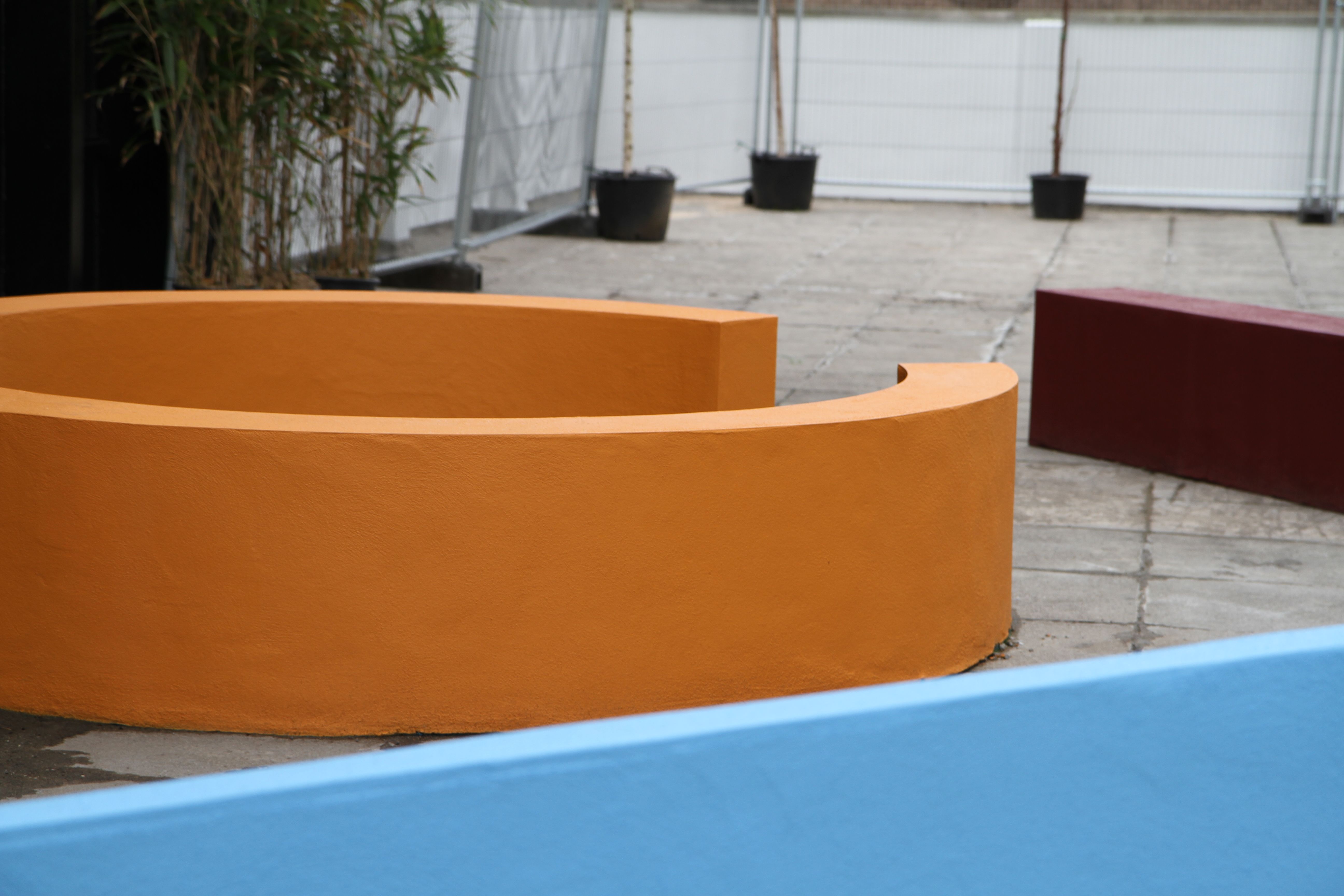
Dialogue of Hands was an outdoor sculpture park for children and adults, located on the open air elevated East Gymnasium of the iconic 1964 building, formerly known as the College of Building and Printing (recently renamed City of Glasgow College). The exhibition was an immersive sensory environment, with an emphasis on real time audience participation and attracting families with children.  The courtyard, which despite its city centre location, was hidden from view and previously unused, was landscaped in homage to the 1960s environments of Brazilian artist Helio Oiticica, using willow trees, flowering cherry trees, birch trees and sensory herbs (lavender and rosemary) and play carpeting in homage to Oiticica’s seminal participation project Eden (Whitechapel Gallery, London, 1969).  The exhibition also referenced Palle Nielsen’s famous Model for a Qualitative Society (Moderna Museet, Stockholm, 1968) which similarly explored the boundaries between art/play, control/freedom and adulthood/childhood.

Sarah Lowndes talks to the Curators & Collections Tour organised by the Contemporary Art Society at Dialogue of Hands (2012)

Dialogue of Hands was named after a collaborative work by Helio Oiticica and fellow Brazilian artist Lygia Clark, in which one of each artist’s hands were joined together within the loop of a paper moebius strip.  The title reflects Oiticica’s belief that the viewer who fully participated in his work was joining a critical experiment in the exercise of freedom.

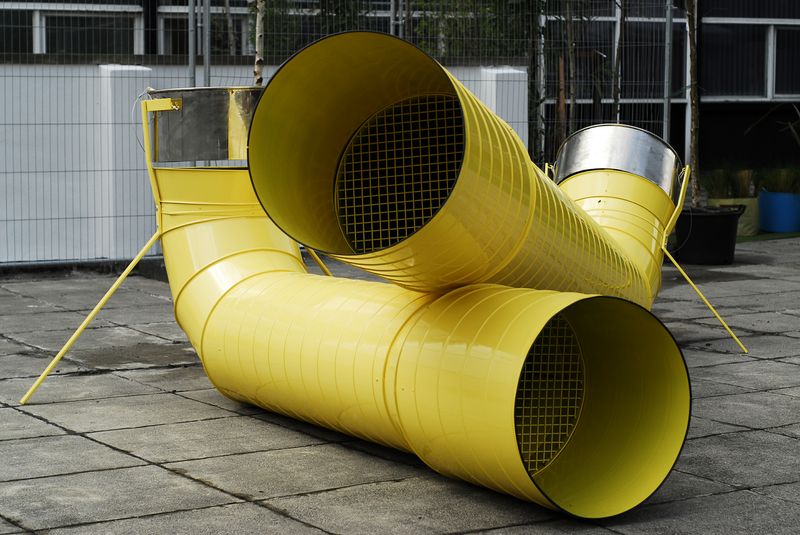
The four artists selected to participate in this group collaborative exhibition project, Chris Johanson (USA), Camilla Løw (Norway), Mary Redmond (UK) and Corin Sworn (Canada/UK), made sculptural works designed to be played with by both children and adults in an outdoor environment.

Corin Sworn, Tent City (2010) Dialogue of Hands (2010)
Corin Sworn, Tent City (2012), Dialogue of Hands (2012)

The brief for the artists participating in the exhibition was to make works that were participatory and invited audience interaction by both adults and children. In contrast to most conventional art exhibitions, there were no ‘please do not touch’ signs in the Dialogue of Hands installation.

Mary Redmond, Tracks (2012), Dialogue of Hands (2012)

The project was envisaged as offering a space for relaxation and exploration both for members of the local community and international visitors attending Glasgow International 2012.

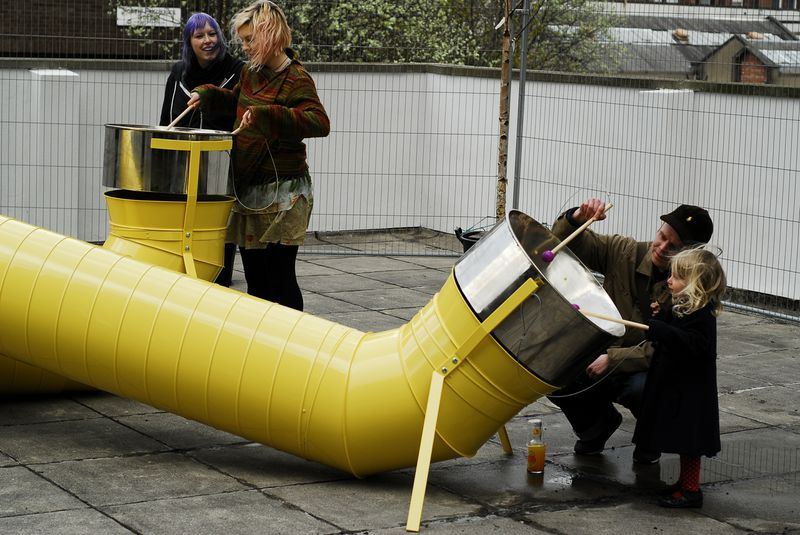
Chris Johanson, The Song The Sun Sent Us (2012), Dialogue of Hands (2012)

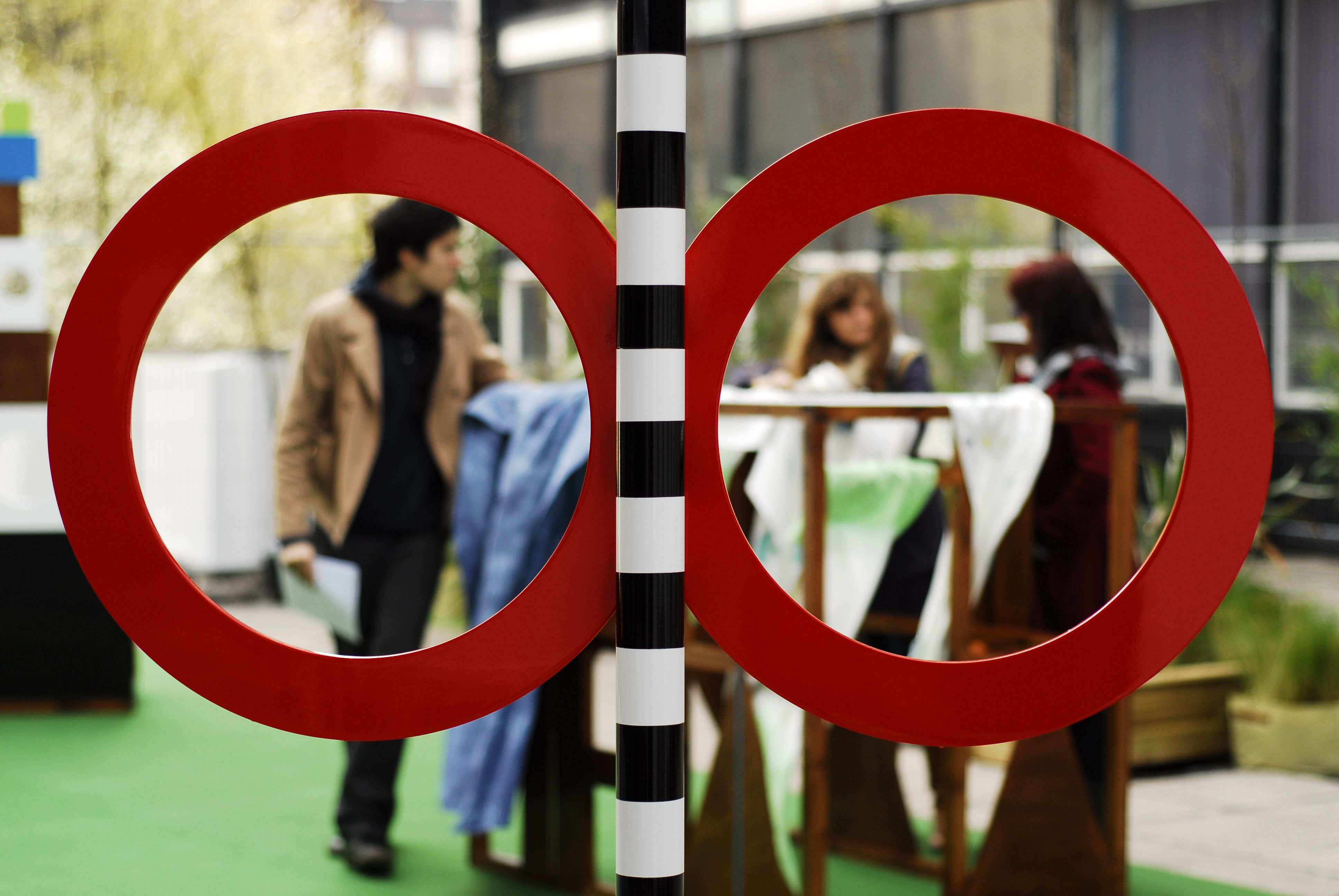
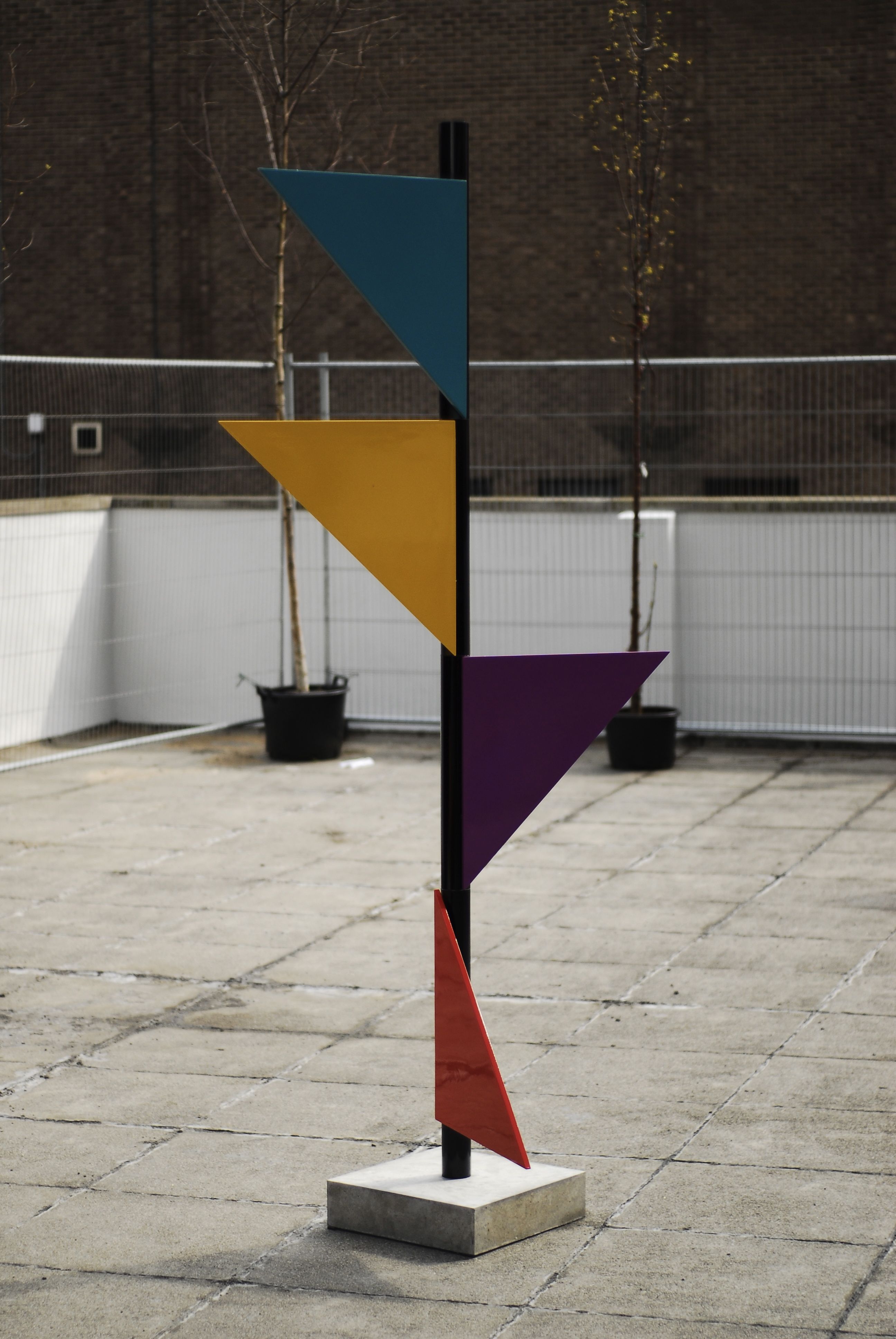
The new commissioned works produced for Dialogue of Hands included a musical sculpture by Chris Johanson called The Song the Sun Sent Us incorporating steel pan drums and to be played by adults and children and two colourful revolving metal sculptures by Camilla Løw, Operator (2012) and Compose (2012), both designed to be turned and touched.

Camilla Low, Operator (2012), Dialogue of Hands (2012)

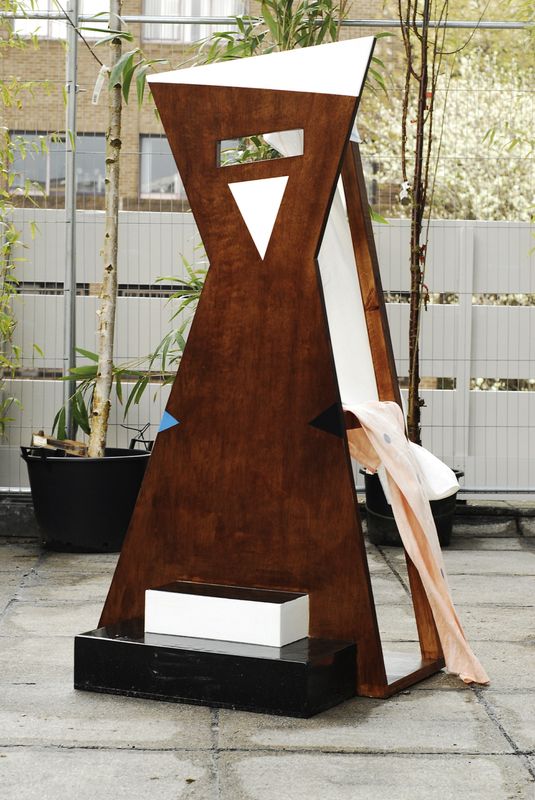
Mary Redmond  produced Tracks (2012) a series of three large site-specific sculptures intended to be touched, as seating, staging and as a prompt to action. Corin Sworn developed Tent City (2012), a series of three sculptural structures, which incorporate peepholes, hiding places and re-arrangeable block printed textile drapes.

Corin Sworn, Tent City (2012), Dialogue of Hands (2012)

Each of the four artists participating in the exhibition had significant interests in sculptural environments, legacies of modernism and audience participation. Chris Johanson’s practice encompasses painting, sculpture, installation, film, video, music, writing and playing in bands. Asked about the motivation behind his art, he responded that ‘life is about looking at and being a part of life. We need to be a part of each other. If we separate we are alone. That is a world of walking dead people. That is why I make art, to talk about how important it is to stay in the now and look at life.’

Camilla Low, Compose (2012)
Camilla Low, Compose (2012), Dialogue of Hands (2012)

Camilla Løw’s work revisits the disciplined formalism of Russian Constructivism, De Stijl and Minimalism. Although referencing those histories, Løw’s work emphasizes the anthropometric qualities of sculpture, suggesting connections between the stable structures of modernist architecture and design and those which are still in motion: the social relationships of inhabitation and response.

Mary Redmond uses a mixture of found objects and divergent raw materials in site-specific and carefully scaled works she describes as ‘something ordinary made strange’. In the past she has spun a web across a gallery or strung pieces of painted wood and a plastic seat together like a mobile. Corin Sworn has made a number of works relating to early childhood education systems, such as a series of photorealist pencil drawings inspired by Summerhill, an alternative school founded in Dresden in 1921 by Scottish progressive AS Neill or ‘Adventure Playground’ (2006), a reconstruction of Danish artist Palle Nielsen’s 1968 adventure playground.

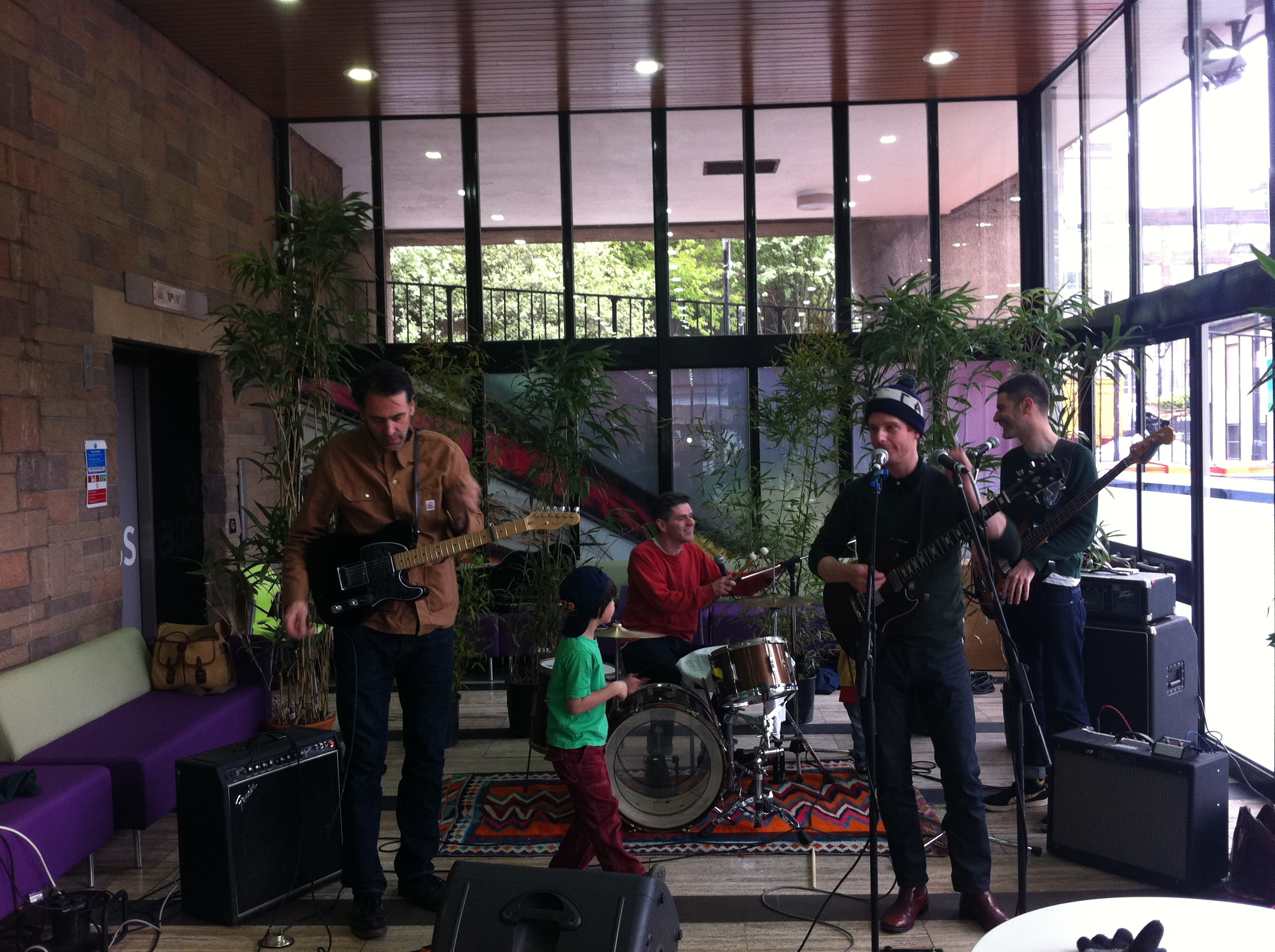
Correcto play the Dialogue of Hands closing party on 7th May 2012.

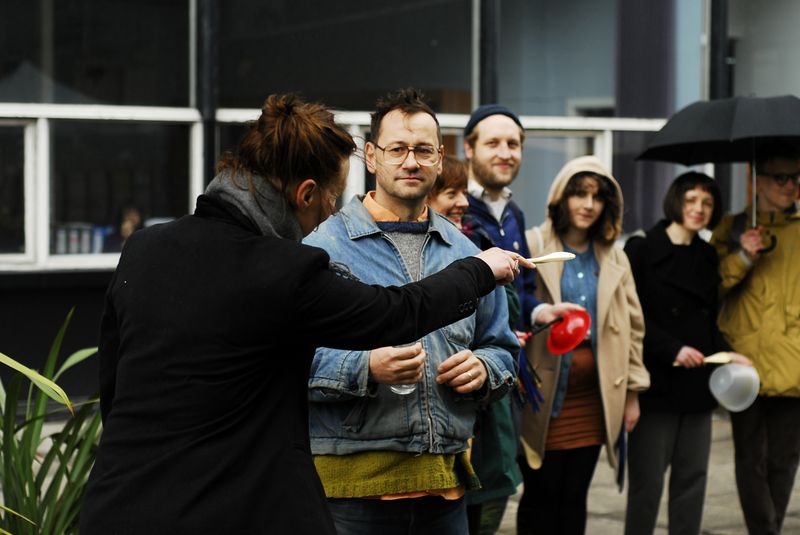
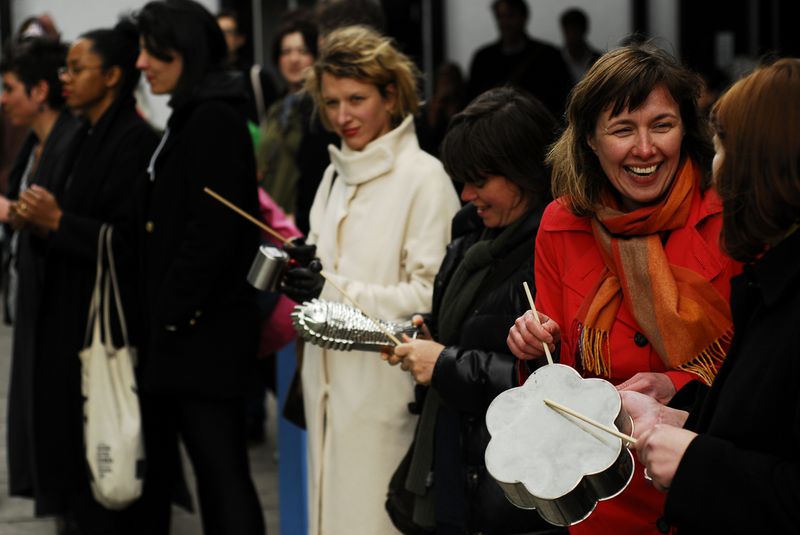
There were a number of free workshops and activities linked to the exhibition, including a storytelling workshop, a make your own parangole (cape) workshop and a make your own musical instrument workshop.  Chris Johanson led a Drum Circle Performance at the opening of the exhibition and Glasgow altpop band Correcto played a free concert at a closing event on the last day of the exhibition.

Participants in Chris Johanson, Drum Circle performance, Dialogue of Hands (2010)
Participants in Chris Johanson, Drum Circle Performance, Dialogue of Hands (2010). Left to right: Luke Fowler, Will Bradley and Krista Blake.
Participants in Chris Johanson Drum Circle performance (left to right: Katie Nicoll, Chris Johanson, Matthew Walkerdine and Jessica Higgins).
Participants in Chris Johanson Drum Circle Performance, Dialogue of Hands (2012) Left to right: Katie Nicoll, Chris Johanson, Matthew Walkerdine and Jessica Higgins.
Participants in Chris Johanson, Drum Circle Performance, Dialogue of Hands (2012).

Notes:

Dialogue of Hands was commissioned by Three Blows (Sarah Lowndes and Katie Nicoll) in association with Glasgow International Festival of Visual Art in collaboration with  City of Glasgow College and with additional support from The Modern Institute.

Photographs of Dialogue of Hands by Martin Clark.

Posted in Curatorial Projects | Leave a comment

Urlibido: A Night of Magic (2010)

Thursday 22nd April 2010

Sloans Grand Ballroom, Glasgow

“The point for me is not to expect perfumery to take its place in some nice, reliable, rational world order, but to expect everything else to become like perfume.”

Brian Eno – Scents and Sensibility Details Magazine, July 1992.

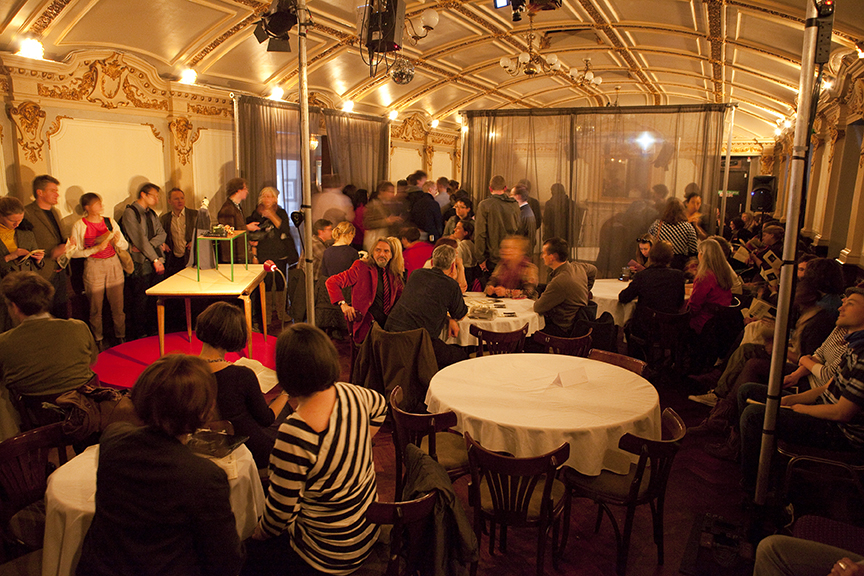
Urlibido was a cabaret-style night, curated and produced by Sarah Lowndes with Kim Coleman & Jenny Hogarth and co-produced with Katie Nicoll for the Open Glasgow section of Glasgow International 2010.

Kim Coleman and Jenny Hogarth, Infusion of the Evening Air, Urlibido (2010)

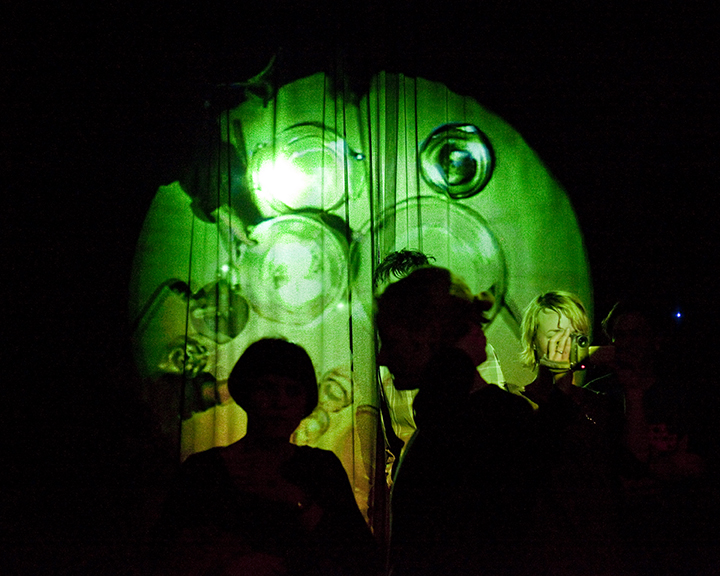
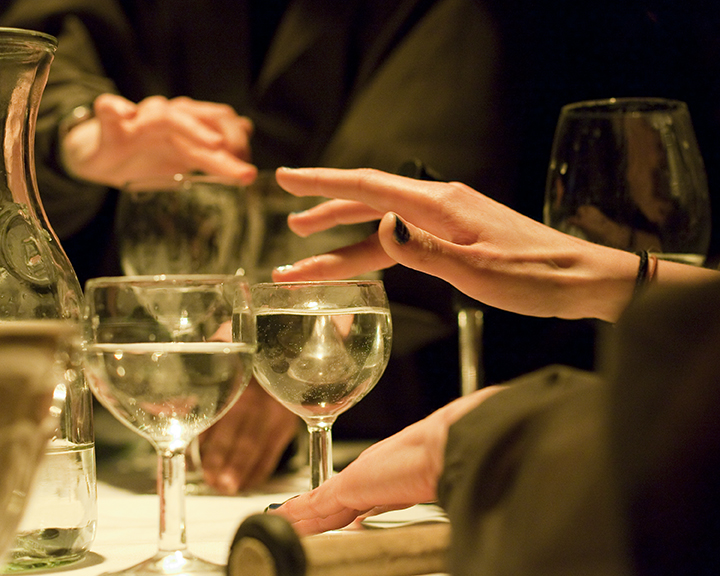
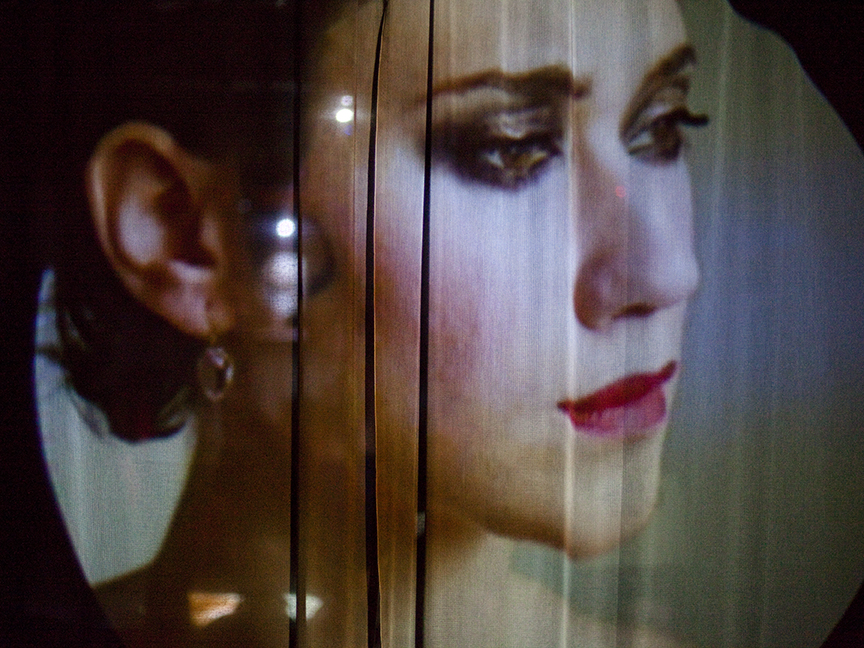
This one–off event was staged in the evocative eighteenth century setting of Sloans Grand Ballroom. Live events included a new performance work by Shelly Nadashi, called Affectionate Still, built around a few still objects, a puppet and a live performer, which examined the possibility of investing still objects with a soul and a will, and how these objects may then affect the performer.   There was also be a live performance by Susie Green inspired by the visions of Hildegard von Bingen, and new collaborative musical compositions by Cara Tolmie and Kimberley O’Neill using song, sampled sound and live performance. The ballroom was re-imagined through projected images of faces made up in 1920 and 30s period styles by make-up artist Morag Ross. Kim Coleman & Jenny Hogarth’s An Infusion of the Evening Air combined audience, performers, stage, seating, tables, curtains and lighting, rendering the mise-en-scène the material of the work. Live camera feeds heightened a sensual awareness of the staging of the event, re-framing the cabaret; a table acting as a stage, the stage performing as a spotlight, the spotlight functioning as ambient light, the performers and audience the subjects of a work created and re-presented live.

Kimberley O'Neill and Cara Tolmie performing at Urlibido (2010)
Kimberley O’Neill and Cara Tolmie performing at Urlibido (2010)

ARTISTS

Kim Coleman and Jenny Hogarth’s collaborative work often uses video and light. They employ light specifically as a material to create immersive installations and sculptural objects. Their performances extend the collaborative relationship further, involving others who become essential to the execution of works, bringing spontaneity and improvisation to staged events.

Urlibido (2010)
Kim Coleman & Jenny Hogarth, An Infusion of the Evening Air, Urlibido (2010)

Susie Green works in a variety of media, with a grounding in sculpture. She completed an MA at Chelsea College of Art and Design in 2008, and at the time of the project lived in Newcastle upon Tyne. ‘I am interested in the fantasy, glamour, and otherworldliness that can be found in, and added to, everyday life. I am intrigued by momentary transcendence and how we can get out of ourselves.’

Shelly Nadashi performing Affectionate, Still (2010) at Urlibido (2010)

Shelly Nadashi’s work is grounded in the live art practices she studied at The School for Visual Theatre in Israel, prior to moving to Glasgow in 2007 to live and work for a time. Her practice remains multi-disciplinary, and includes video making, live performances, sound design, puppetry and written texts.

Kimberley O'Neill and Cara Tolmie performing at Urlibido (2010)
Kimberley O’Neill and Cara Tolmie performing at Urlibido (2010)

The artist filmmaker Kimberley O’Neill was born in 1982 in Bellshill, Scotland and at the time of the project was based in London. Her practice spans film & video, sound and drawing. O’Neill says, ‘My work looks at the human desire to relate to the other, examining the individual within personal relationships, in social contexts and interacting with their environment. […]  My video works and drawings focus on the body, and the space it inhabits, in moments of transformation and spectacle. Depicting individuals declaring themselves autonomous from society.’ O’Neill collaborated with Cara Tolmie to create new musical compositions for Urlibido.

Morag Ross, Urlibido (2010)

Morag Ross is a leader in the field of on-screen make-up, who studied art and design at Glasgow School of Art and began her career working for BBC London.  Her numerous credits include the classic Derek Jarman films Caravaggio (1986), Aria (1987) and Edward II (1991).  Since she has affected many acclaimed make-up transformations, including the make up for Neil Jordan’s movie The Crying Game (1992) in which the male actor Jaye Davidson played someone who appeared to be female, and Sally Potter’s Orlando (1993), where Tilda Swinton plays a man for part of the movie. She also did the make-up and hair for Cate Blanchett to play Bob Dylan in Todd Haynes I’m Not There (2007).  Her numerous other credits include Charlotte Gray (2001), The Aviator (2004) and Elizabeth: The Golden Age (2007). In 2008 she was awarded a BAFTA Scotland Award for Craft (In Memory of Robert McCann) and in 2004 she won the BAFTA Film Make-Up and Hair Award.

Cara Tolmie works with video, performance, sound, text and object. From 
2006 to 2008 
she was Secretary and Committee Member of Glasgow’s artist-run Transmission Gallery.  Her exhibitions include:  
The Boethian Slip, Generator Projects, Dundee (2008), Die show im Oktober Transmission Gallery, Glasgow
 (2009) and Grey Matter, Talbot Rice Gallery, Edinburgh (2009).  Tolmie was selected as one of the eight LUX Associate Artists for its 2009/10 programme.  Tolmie collaborated with Kimberley O’Neill to create new musical compositions for Urlibido.

Review

Martin Vincent, “Open Sea”, blog commissioned by Axisweb.org

Affectionate Still
For weeks it seems I’ve been seeing Shelly Nadashi carrying that table around. She brings it into the CCA, and then the next day I see her carrying it again along Sauchiehall Street. An insignificant table – oblong, smaller than coffee table sized, too thinly proportioned, somewhat fragile-looking.

Thursday night, and I’m about to find out what it is for. Sloans is an 18th century bar in Argyll Arcade – three floors of mahogany and marble topped off by the vaulted ceiling of the Grand Ballroom. Good for wedding receptions and evenings of decadent experimental high art cabaret entertainment, such as is happening this evening under the title ‘Urlibido – a Night of Magic’.

This is yet another occasion of multi-layered credits and overlapping performance. Part of the ‘Open Glasgow’ section of GI, curated and produced by Sarah Lowndes and Katie Nicoll (under the banner ‘Three Blows’) with Kim Coleman & Jenny Hogarth. The latter duo are largely responsible for projections, settings, curtains, lightings and the generally disconcerting sense that at any time the place you are standing can be transformed from quiet corner to spot-lit centre-stage.

We’ve queued up the stairs and had our hands stamped by the curator, performances begin with Cara Tolmie and Kimberley O’Neill…

I saw Cara Tolmie perform a week previously at the GI opening at Tramway. She had a microphone and one of those pedals that loops what you’ve just sung. Beginning with a simple low chant, she walked in a circle and pressed the pedal at each revolution, ‘The story we endure/knows nothing of us…’ the vocal layers built gently, melodies and harmonies overlaid, higher and higher up the range to an exhilarating soprano crescendo. Quite a vocal talent – which is not something you’re encouraged to expect in an art context. ‘The end is a tumultuous noise’ it was called.

…at the piano and various bells and percussion. There’s a big transparent curtain down the middle of the room, which you’re not supposed to disturb because there’ll be projections on it. But the place is rammed and hard to navigate, with some folk safely ensconced at round tables that the rest of us have to walk between and a circular stage that no one will perform on.

Susie Green takes a position in front of the central curtain and begins a routine of dramatic dance moves whose gestures follow (or seem to invoke) light projections – it’s inspired by the visions of Hildegard von Bingen and is, rather spookily, just as you would imagine this kind of thing would be.

Through the evening Tolmie and O’Neill pop up in different parts of the room, and even on the stairs – visible in the room on moving projections, it’s an all-singing all-dancing affair. Then there’s that table.

Now sat on top of another table, and with objects upon the top and a puppet standing behind it. The proportions make perfect sense now – it’s a scale model. Shelly Nadashi stands behind the puppet, and the performance is a revelation. After a series of gestural movements which draw our attention and allow a slight trance to descend upon the room, she holds the puppet by the back of its head and gives it voice as it disdainfully examines the objects laid out before it, which end up being flung across the room or swept onto the floor. It’s a bleak diatribe with lines I want to remember but which are themselves swept away as Nadashi’s malcontented marionette wrestles with corporeality, love and humanity in the context of twentieth century art and war. It’s relentless and pretty scary and funny too (especially when the artist cracks herself up with a topical line about cannibalism at the airport.)

Nadashi trained at the School for Visual Theatre in Israel, she knows exactly what she’s doing and we’re all a bit stunned at what we’ve witnessed.

Notes:

All photographs of Urlibido by Gary Gordon.

Urlibido: A Night of Magic was funded by the Scottish Arts Council through the Open Glasgow initiative for Glasgow International Festival of Visual Art. ‘Open Glasgow’ is a new initiative for Glasgow International Festival of Visual Art which aims to discover ambitious and imaginative artists’ projects, conceived specifically for the city during Festival time.

With additional support from Schloss Bröllin and The Ministry of Education, Science and Culture of Mecklenburg-Vorpommern.

Posted in Curatorial Projects | Leave a comment

Votive (2009)

Centre for Contemporary Art, Glasgow 5th December -30th January 2010

Curated by Sarah Lowndes

‘Every event is an object anyway and every event has object-like quality’ George Brecht

Votive examines the idea of object as event, addressing the idea of performativity enshrined in the votive offering. A votive offering either expresses a wish or is given in thanks for a wish fulfilled. It is thus both sculptural (existing in space) and performative (existing in time, as an event, and thereafter as a memory). Many of the objects included in the exhibition have qualities similar to amulets, charms and talismans, which work by magical and not physical means. Johan Huizinga, in his important study of the play element in culture, Homo Ludens (1940), observed that ‘[…] in giving expression to life man creates a second, poetic world alongside the world of nature.’ This activity, the act of representation, the creation of a second poetic world, is the focus of the Votive exhibition. The offering of votive objects sets in place a contract, whereby the object becomes a physical marker of something imagined which could yet become real.

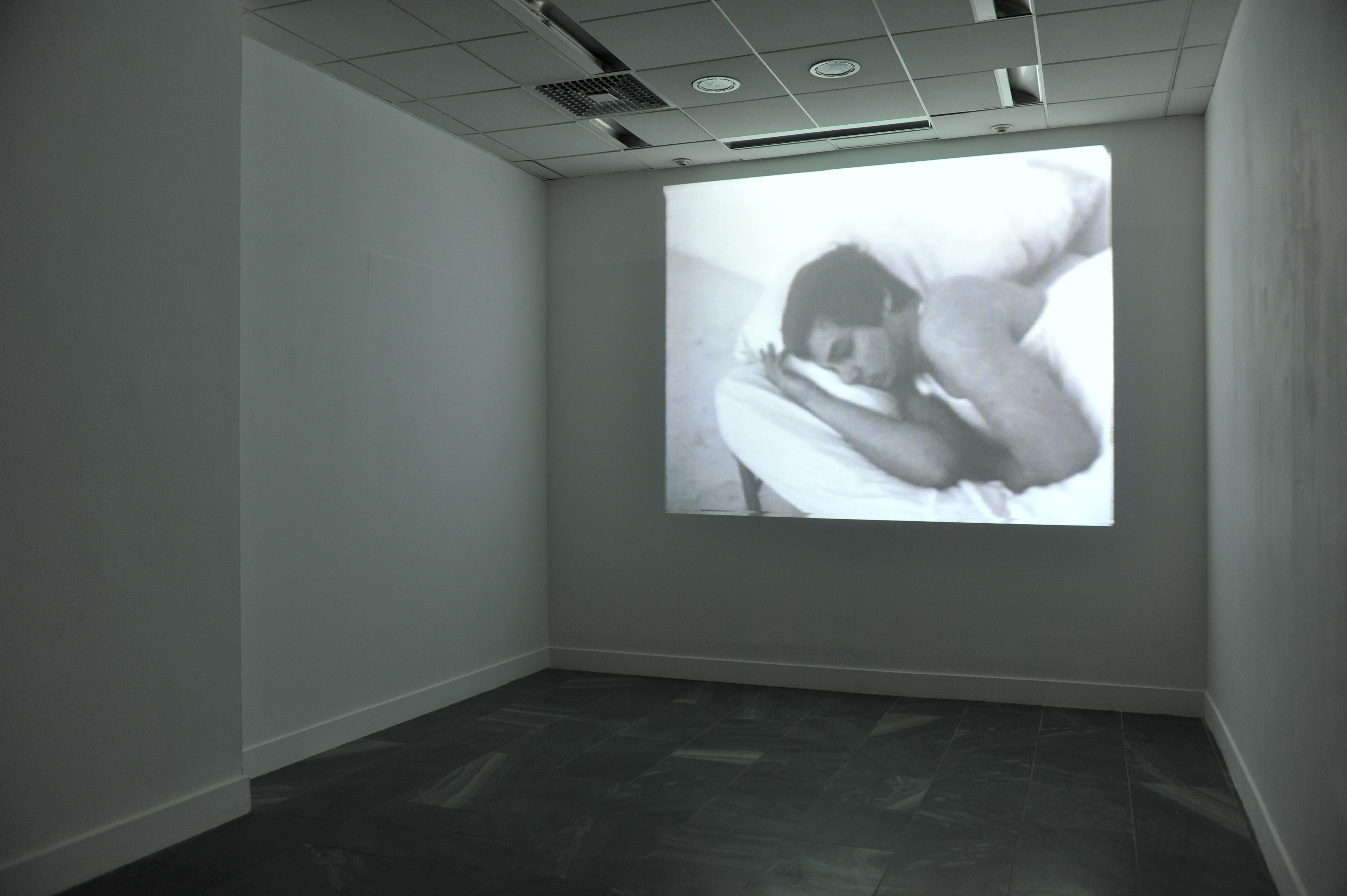
Chris Burden, Bed Piece (1972) on display in Votive (2009)

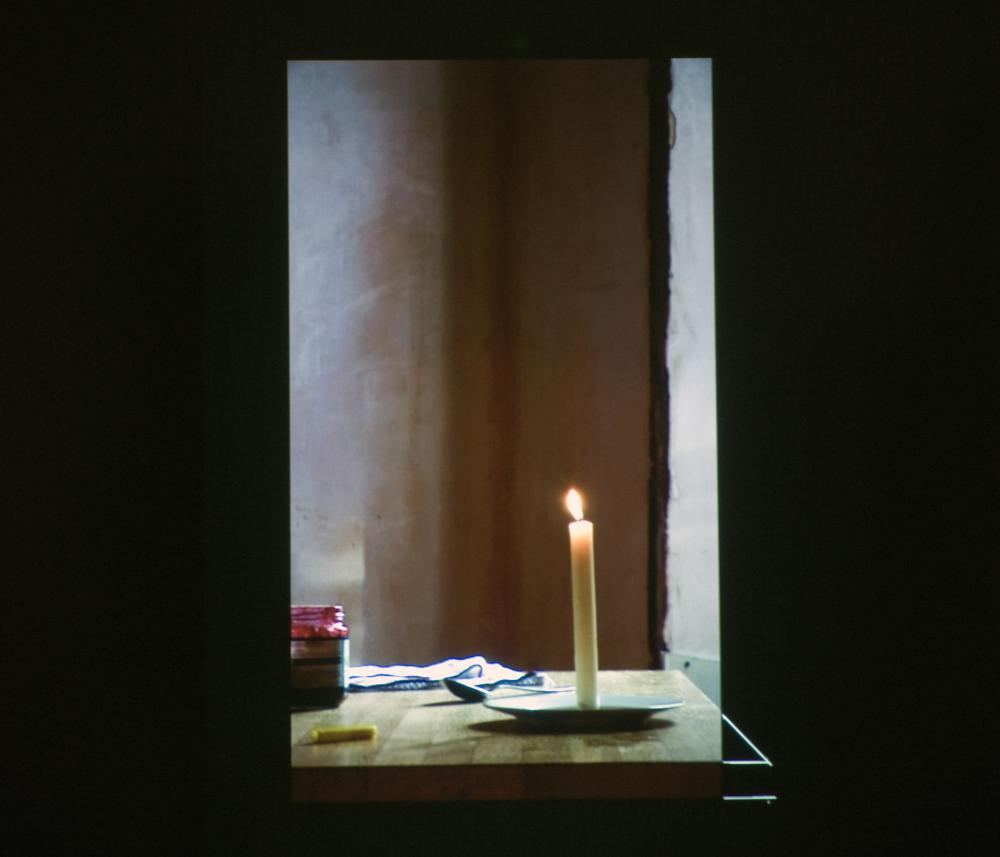
The Super 8 documentation of Chris Burden’s seminal concrete performance piece Bed Piece (1972) is a cornerstone of the Votive exhibition. He described some of the underlying motivations of his early performances by explaining, ‘…there are considerations like the myth and the reality, fantasizing something and having it be real – the early pieces were apparitions.’ Apparition can be interpreted in two interconnected senses – a ghost or ghostlike image of a person, and the appearance of something remarkable or unexpected. The word derives from ‘the action of appearing’. This idea of the action of appearing is significant in thinking about all of the works selected for inclusion in this exhibition. The ghostlike quality of the documentation of Burden’s work is also present in Torsten Lauschmann’s film installation Dead Man’s Switch (2008), which depicts a single candle burning on the kitchen table in the artist’s home. This vision of almost stillness elides the temporary and ephemeral nature of the live event, to fix the flame in an eternal present. The phased action of appearing is converted into the plenitude of the appearance itself, stripped of both preamble and aftermath.

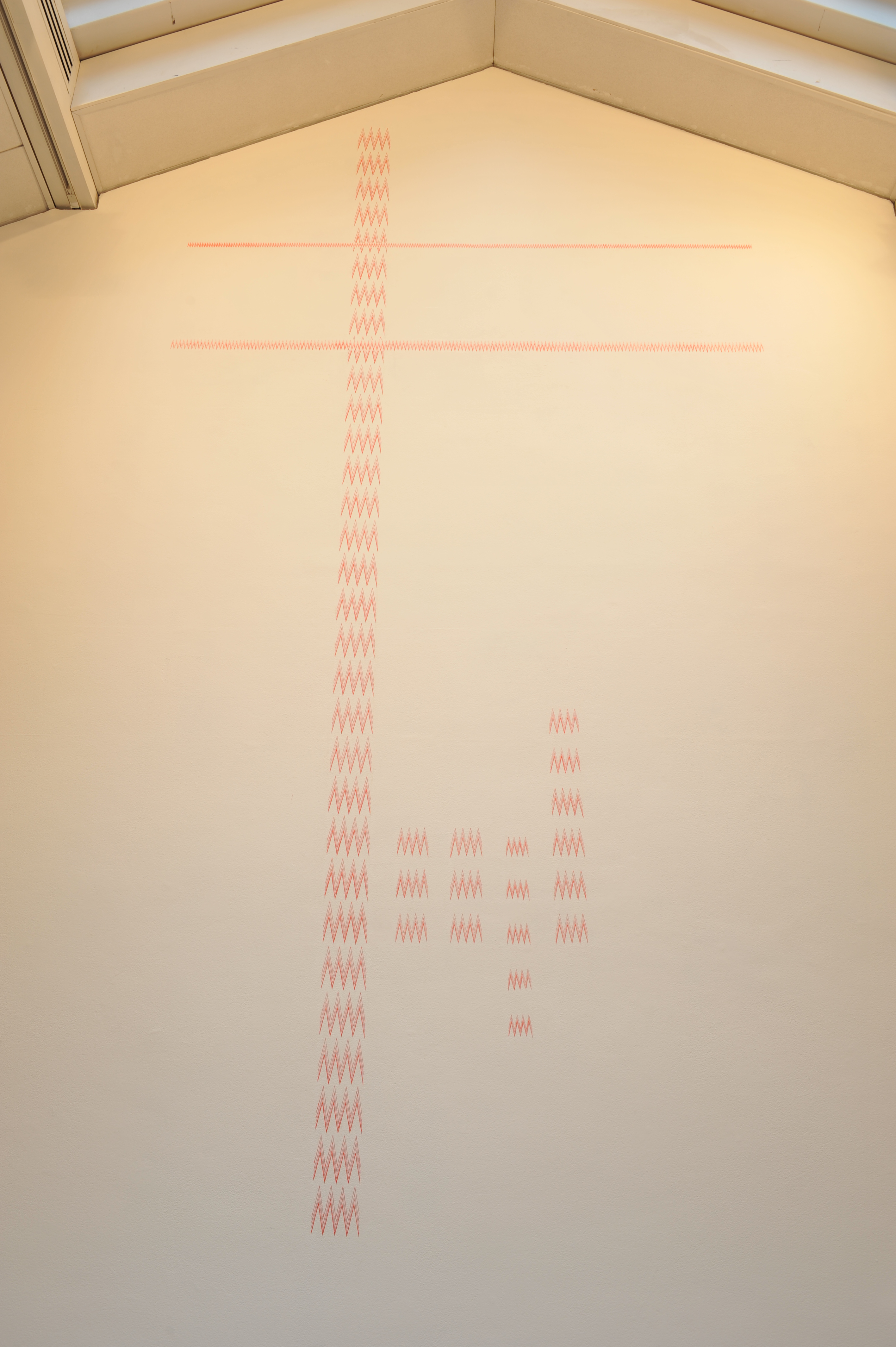
Richard Wright, No Title (2009) on display in Votive (2009)

The notion of an apparition recurs in considering Richard Wright’s wall paintings, which often take weeks of tremendous physical effort to produce, yet manage to transcend the painstaking method of their production to transmit an experience of clarity and lightness to the spectator. Wright explains, ‘I always say that painting is a physical act; it is about touching matter, but paradoxically painting is essentially immaterial. It is a projection.’ This aspect of projection is evident in Wright’s practice, in which his meticulous and highly complex wall drawings articulate muted or unspoken aspects of the architecture. The predestination of the work (which is usually destroyed at the end of each exhibition) means that in an important way it becomes itself through disappearance.

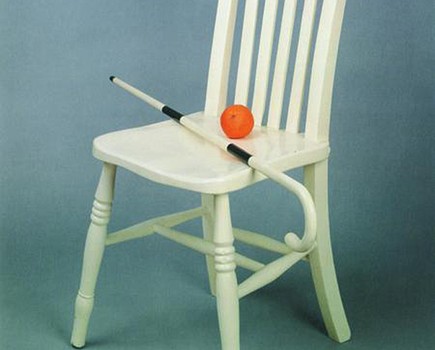
Devotional objects effect a bridge between sculpture and performance which resonates in the work of George Brecht, a key member of the Fluxus group, who developed John Cage’s Eastern philosophy derived ideas of chance alongside colleagues such as George Maciunias and Yoko Ono. Brecht’s work demonstrates the possibility of sculpture as a prompt to action, whether actual interaction with the objects (as was the case in the early years of his work) or the imaginary acts his work now inspires in spectators. His seminal Chair Event works of the 1960s, in which objects such as a lit candle, or a walking stick and an orange, are placed on a chair, generate a sense of preceding action or an event that has yet to occur.

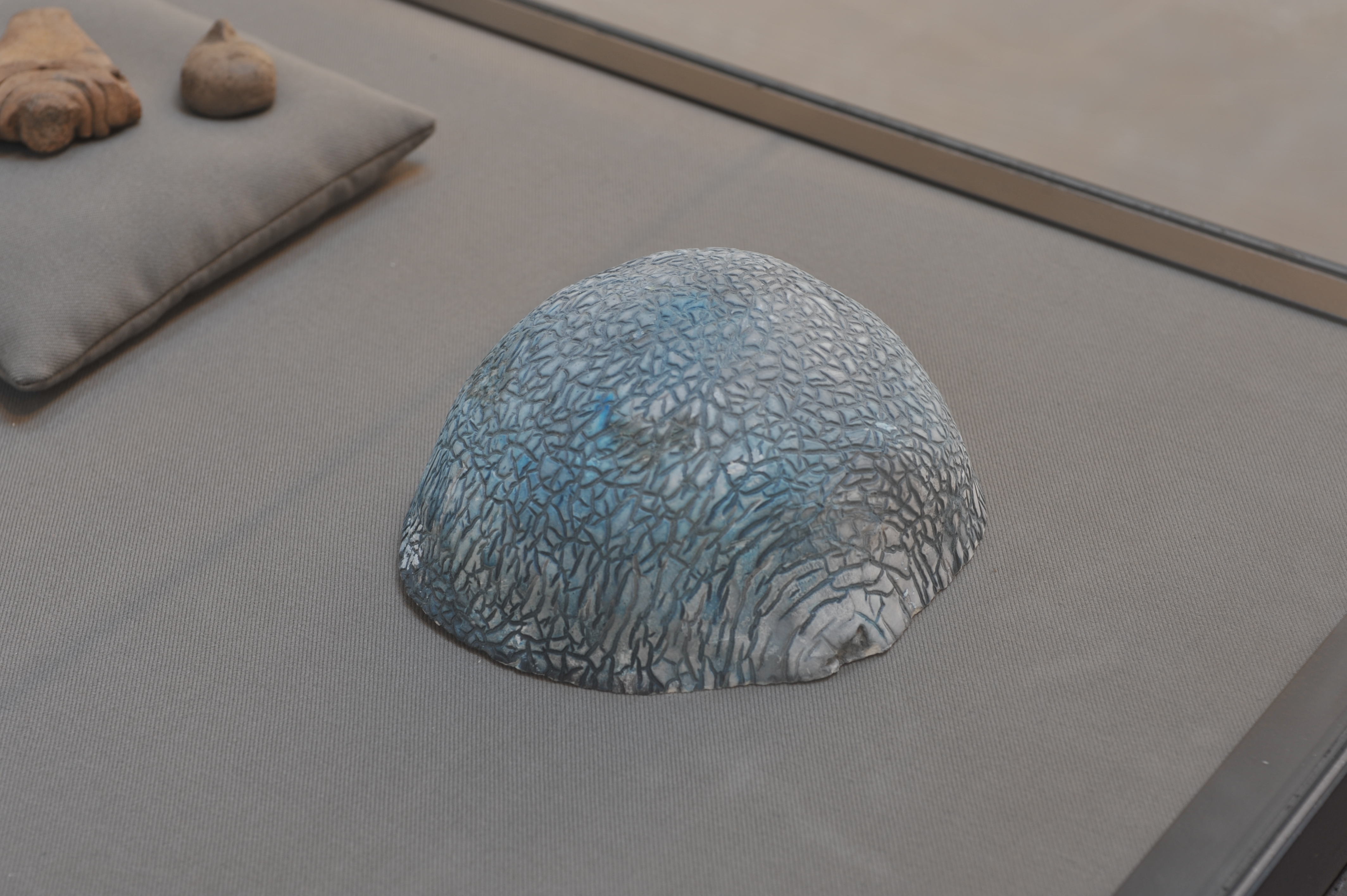
Thea Djordjadze, Untitled (2008) on display in Votive (2009)

The idea of event as object / object as event is handled differently by Thea Djordjadze – she composes nuanced arrangements of forms, using pliable, fragile and ephemeral materials and techniques that foreground the hand of the individual, such as knitting and moulding. Her process-based sculptures possess similar properties to amulets, charms and talismans, in that the manner of their handling gives them a second existence beyond their everyday status. Although amulets, charms and talismans are real objects, their magical properties operate as ‘acts’: their magic inheres in things done and said rather than in the things themselves.

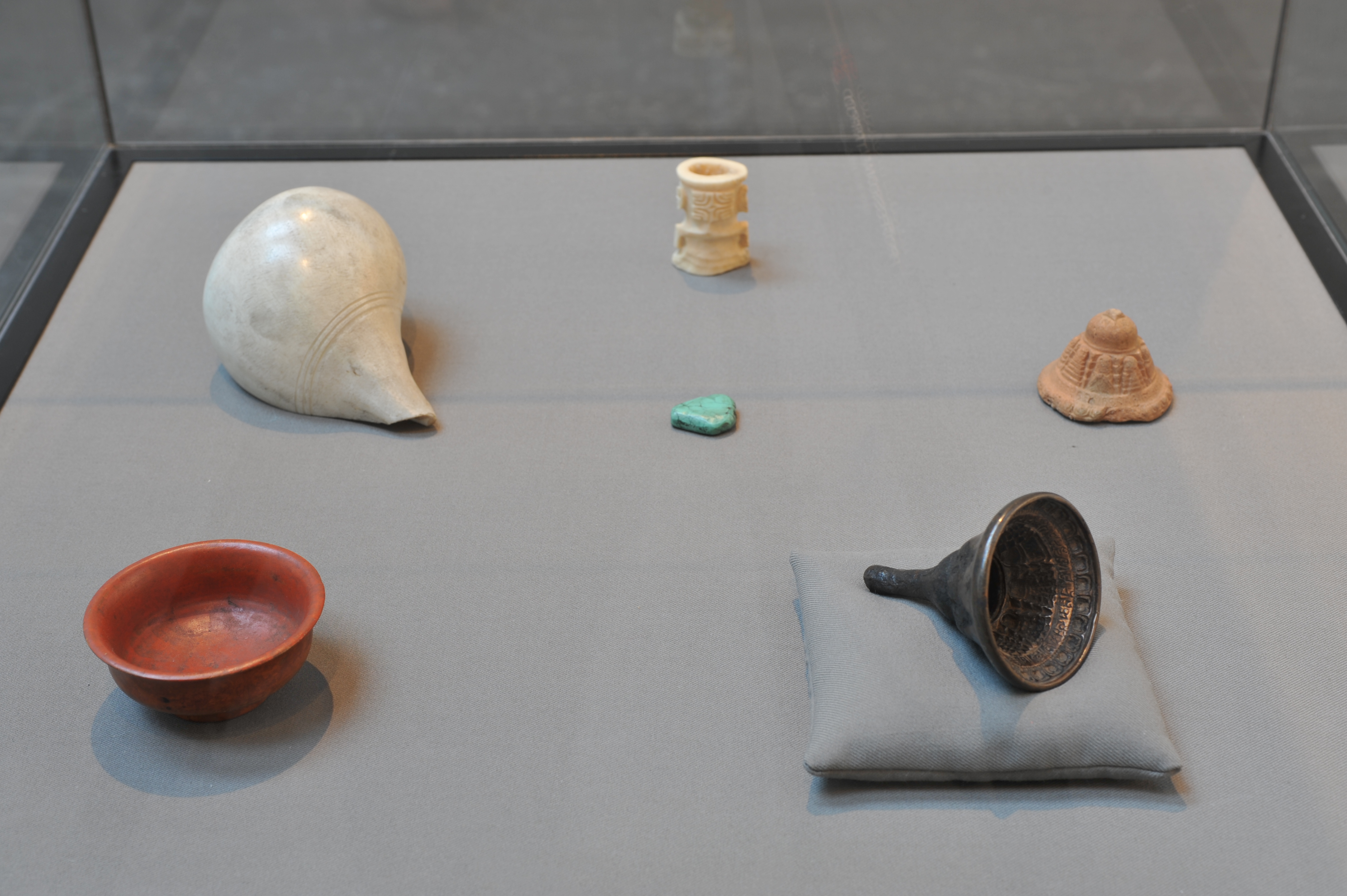
Glasgow Museums have generously loaned twelve objects from their world-renowned World Cultures Collection to the Votive exhibition. In many of these objects, the natural world and the poetic world co-exist: as for example in the turquoise bead, used in decorating headdresses, from a collection of ethnographical objects from Tibet which, for traders in salt of the Himalayan region, had an amuletic function, in averting sickness on journeys. Similarly, the trumpet conch-shell, from Tibet, used in worship along with cymbols and also placed on altars is a natural form that has a symbolic, cultural meaning and function. The other objects selected are man-made, but similar to the turquoise bead and the shell trumpet, their use or significance may not be immediately apparent to the observer. Several of the objects possess a duality, being both functional objects and also possessing symbolic meaning, for example the wooden bowl, with red interior, used for tea and food, from Tibet, which was used by pilgrims both for ordinary meals and for making offerings, and the holy water bowl, made in Lhassa, from a collection of ethnographical objects from Tibet, which perform both a practical and a ritualistic function, both containing water and symbolizing the cycle of life. Similarly, the bone figure used by the natives for tightening the skins on their drums, from a collection of ethnological specimens from the Marquesas, South Pacific, is not only a musical tool but also a fetish.

Objects from The World Cultures Collection of Glasgow Museums on display in Votive (2009)

A number of actual votive offerings have been selected for inclusion in the exhibition, which serve no practical function, other than their use in specific rituals, such as funerary rites. These objects include acone shaped mould for marking votive stupas, from Tibet and a small terracotta votive stupa, from Burma. Also on display will be a figure of a human head and two miniature masks of terracotta from Mexico, found near the Pyramid of the Sun, San Juan, which are believed to be either funerary figures or votive offerings. The exact significance of the Mende or Sherbo Nomoli figures in soapstone is also unknown, although it is believed that they are either fetishes or votives. The mysterious nature of these objects means that they hold great potential in terms of interpretation, particularly in the context of the Votive exhibition, where their performative and sculptural qualities are highlighted.

Nerea Bello performs at the opening of Votive at CCA, Glasgow, December 2009

Abraham Cruzvillegas’ silk-screened works on paper are based on political protest posters, and are both documents of historical struggles and reflections of what the artist calls ‘real experience: subjective, warm, live.’ The message of resistance and of hope communicated through these works provides another instance of an object that may also presage an event. On the opening night of the Votive exhibition there was a live song performance by the Basque singer Nerea Bello, Bello’s remarkable vocal range and mastery of different song idioms generates song performances that are suspenseful and captivating – a recording of her opening night performance can be heard at one-hour intervals during the exhibition. Bello uses objects in her performances such as a radio, a tambourine or a spinning top, that become a means of moving through both physical and imaginary space, much as the ex-voto offering of a gold ring or a burning candle is but the concrete marker of activity emanating in the realms of the imagination.

Sarah Lowndes.

Torsten Lauschmann, Dead Man's Switch (2009)
Torsten Lauschmann, Dead Man’s Switch (2008)

Description of works:

Nerea Bello, accompanied by Shane Connolly (2009).  A recording of a performance made on the opening night by Basque singer Nerea Bello in response to the other works in the exhibition. Bello has a ‘passion for voice, the broken voice that carries bad news, that of a distant argument, of protests and after dinner songs, laughter, whispers, breaths, howlings of labour, sadness, joy. Voices tuned to train sounds, to radios crackling, to a baby’s cry, a toy, a bread maker, thunder, car horns, anything is an excuse to experiment with voice’. The recording will be played at one-hour intervals in the exhibition space.

George Brecht, Chair Event (1969).This important and rarely seen sculpture consists of a whitewashed chair, on the seat of which are placed a walking stick painted with black and white stripes and an orange. Brecht’s work demonstrates the possibility of sculpture as a prompt to action, whether actual interaction with the objects (as was the case in the early years of his work) or the imaginary acts his work now inspires in spectators. He once described his art as a way of ‘ensuring that the details of everyday life, the random constellations of objects that surround us, stop going unnoticed.’

Chris Burden, Bed Piece (1972).The Super 8 documentation of Chris Burden’s seminal concrete performance Bed Piece, in which the artist undressed and remained in bed for 22 days, is problematic because it can never fully convey the power of Burden’s vigil-like performance, which he has described as the ‘strangest, most powerful piece’ from his early career. Burden described his body as generating a force-field like ‘a repulsive magnet’ during the performance, an effect reversed in the Super 8 film, which onlookers cluster around to observe the supine body of the young artist.

Abraham Cruzvillegas, Ink & Blood: 1968-2009 (2008-2009). For Votive, Cruzvillegas sent from Mexico City to Glasgow a portfolio of screen-prints based on political protest posters – as a gesture of faith and an acknowledgement of the ideas implicated in the postal art of the 1960s and 70s. A different poster from the portfolio will be shown at ten-day intervals throughout the exhibition in vitrine two. Cruzvillegas has donated his fee for participating in the exhibition to Amnesty International.

Thea Djordjadze, Untitled (2009), Untitled (2009)and Untitled (2008).The Georgian-born Berlin-based artist Thea Djordjadze has selected three works for the exhibition. There is a quiet insistence on a relational rather than absolute idea of time in Djordjadze’s works: in the modernist referents of the framing devices and supports, the ghosts of the real objects that the plaster casts take their imprint from and in the history of making that is knotted into the weave of the nomadic carpets.

Torsten Lauschmann, Dead Man’s Switch (2008). Torsten Lauschmann’s film installation, Dead Man’s Switch was commissioned for the ICA’s Nought to Sixty series and depicts a single candle burning on the kitchen table in the artist’s home: the film image appears and disappears at timed intervals. This work alludes both to votive offerings and to Gerhard Richter’s painting Kerze (1983) which appeared on the cover of Sonic Youth’s 1988 Daydream Nation album – but like Lauschmann’s earlier films of ‘almost still’ subjects it also reveals the tension between the absent contingency of the real and the static, endless quality of representation.

Richard Wright, No title (2009).A new commission from 2009 Turner Prize nominee Richard Wright, who makes site-specific wall drawings which respond to both the emotional and physical qualities of architecture. Working predominantly with paint and gold leaf directly on walls, his work relies upon intensive and laborious processes, yet the clarity of the finished work reveals none of the commitment required to render the immaterial concrete.  Most of his work exists only for the duration of a given exhibition, but thereafter may appear to haunt both the space and the spectator’s memory.

Objects loaned from the World Cultures collection of Glasgow Museums.

Lent by Culture and Sport on behalf of Glasgow City Council

Vitrine One    

Holy water bowl made in Lhassa.  From a collection of ethnographical objects from Tibet.

Figure of a human head (bald head, female) in terracotta from the neighbourhood of Mexico City. From a collection of Prehistoric Implements from Mexico.

Figure of a human head & Mask of terracotta (bald head, male) and mask of terracotta (torso) found near the Pyramid of the Sun, San Juan, Mexico.

Nomoli figure in soapstone, Mende or Sherbo.  The head has nose and mouth thrust forward and ears placed well back.  Flattened nose with wide nostrils, teeth bared.  Attached by brass peg to rectangular wooden plinth.

Small fragment of a nomoli figure in grey soapstone. Mende or Sherbro with a pair of arms with hands at one end, either side of a large piercing.  Above the arms is a worn s-shaped section, possibly the remains of a head.

Thea Djordjadze, Untitled plaster and watercolour. 2008

Vitrine Three

Wooden bowl, with red interior used for tea and food. From a collection of ethnographical objects from Tibet.

Turquoise bead used in decorating head dresses, flat triangular shape.  From a collection of ethnographical objects from Tibet.

Trumpet – conch-shell, used in worship along with cymbols and also placed on altars.  From Tibet. Gifted by Mrs. Thomson

Mould – cone shaped, for marking votive stupas.  Shows band of inscription near rim and on head of mould around square pin top.  From Tibet. Gifted by Mrs. Thomson

Small terracotta votive stupa – Buddhist, from Burma.

Bone figure used by the natives for tightening the skins on their drums.  From a collection of ethnological specimens from the Marquesas, South Pacific. gifted by C.M. Stuart

There was also a series of events related to the exhibition, including a screening of Andrei Tarkovsky’s Andrei Rublev (1966) on the 13 January and a talk on the theme of Object as Event with curator Sarah Lowndes and artists Richard Wright and Torsten Lauschmann on the 28 January.

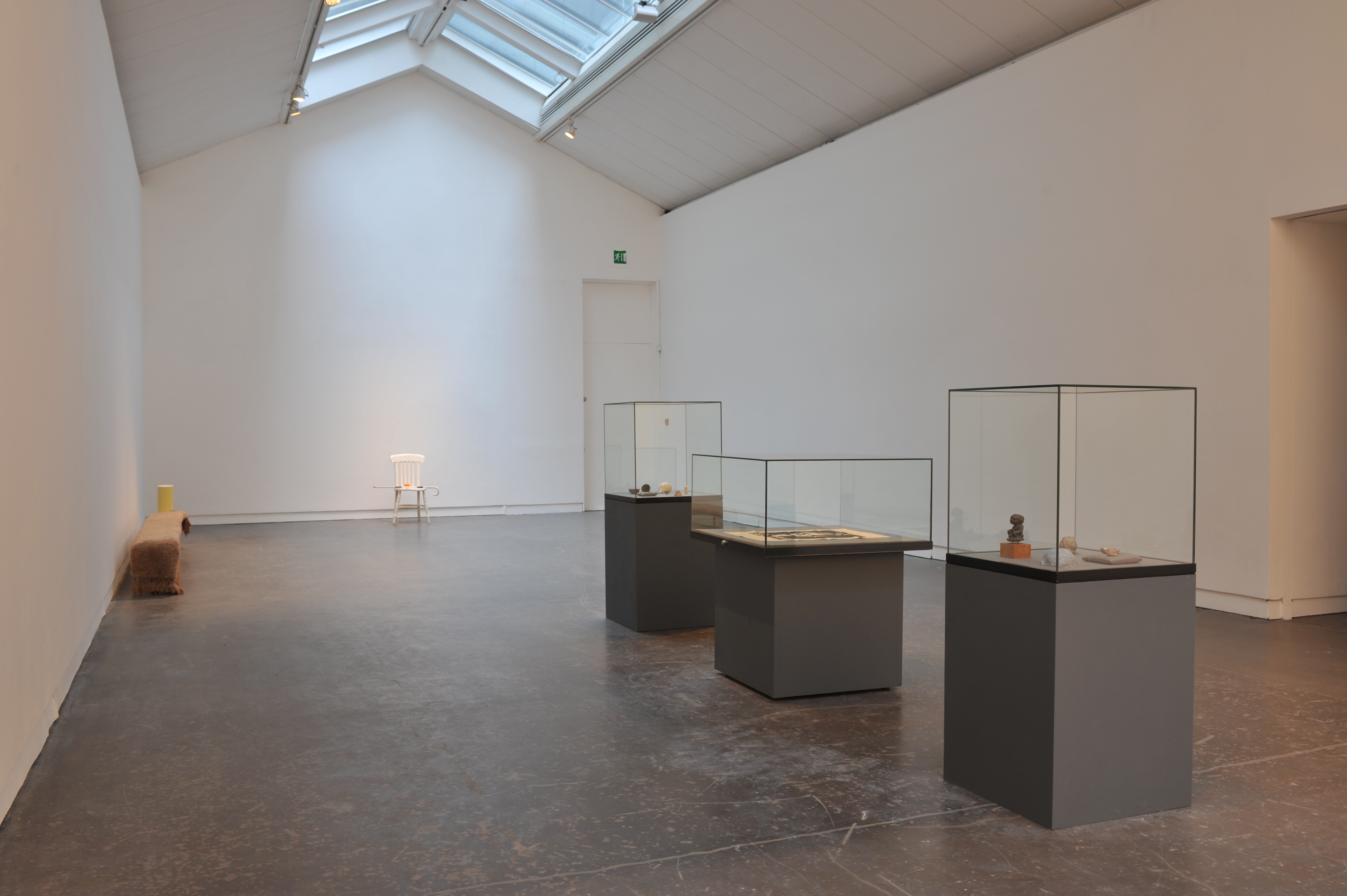
Votive, CCA (2009) Installation view
Votive, CCA (2009)
Installation view

Reviews

Ken Neil, “Votive”, Map #21, February 4th 2010.

Writer, academic and curator Sarah Lowndes has gathered a variety of subtly poetic artworks and arranged them as if according to the uncanny logic you might meet at the heart of a dream. Votive is an economical exploration of three central themes: the intrigue generated by those carefully fabricated things which have since time immemorial supported magical narratives; the awe that even secularists can register when close to the minds and manners of humans capable of extraordinary devotion; and the idea of ‘sculpture as event’ – matter fixed in the moment it is beheld but which inspires imagined episodes, post and ante.

A grainy black and white filmed recording of Chris Burden’s eerie ‘Bed Piece’, 1972, is a powerful mood-setter for the show. Burden, on public display in a Californian gallery, stayed in bed for 22 days, speaking to no-one. In one shot the camera hovers over Burden’s face; he’s sleeping, like a doomed convict. In another he seems to express a monkish contentedness and in yet another, he is seen from afar, his performance symbolically miniscule against the role of expansive nothingness played by the studio wall.

Burden’s asceticism lingers in mind in the space of Torsten Lauschmann’s ‘Dead Man’s Switch’, 2008. Projected onto the wall of what feels now like a darkened transept is a mesmerising window of colour. With something of the nostalgic richness of a Vermeer and the contemporary look of a Richter, the projected image shows a lit church candle on a kitchen table next to breakfast condiments. The zone of light is magnetic after Burden’s monochromism; but as pious beholding turns into viewing pleasure the gallery light comes on and the projection pales. The wick issues a wisp of smoke as trace of its extermination. A hand appears, relights the candle, and darkness conversely returns to real space. The dead man’s switch, that morbid safety feature which anticipates the demise of a human operative, and covers for it, appears to have been activated by us.

Into the nave – at each end Richard Wright and George Brecht present signature pieces. Thea Djordjadze and Abraham Cruzvillegas make offerings in between. In addition, two vitrines display actual votive objects selected by Lowndes from the Glasgow Museums’ World Cultures Collections. Some have been identified as components of funerary rituals, others remain now distant from original use, so the primed viewer begins to place them in sequences of events in an invented narrative.

Georgian artist Djordjadze’s surrealist works of materially contrasting artefacts – woven nomads’ rugs, smooth plaster, wooden supports – are quickly anthropomorphised by the conditioned mind; skin, cranium, skeleton, appear in place of the inanimate. The invoked transubstantiation parallels the scripted transformation to follow those acts of religious communion which are structured around symbolic objects as markers of faith.

Brecht’s ‘Chair Events’, 1960s, most clearly signal the role of sculpture-as-event, and by now one is attuned to speculate on the before and after-life of the chair the cane and the orange. Although the telegraphed surrealism doesn’t match Lauschmann’s poeticism or Djordjadze’s idiosyncratic invention, the peculiar tension between Brecht’s items-as-things-inthemselves and items-as-signs-of-actsunseen is worthy of contemplation.

Looking back from Brecht towards what is convincingly the apse, the delicately unnerving wall drawing of Wright comes into its own. Wave-like patterns in red gouache are spread up the height of the architecture and perpendicularly to that axis. The wall work is engagingly hard to account for: might this formation be cruciform, or is the aesthetic that of a cardiograph?

The eye is taken up and out of the main gallery space by the verticality of Wright’s composition. Indebted to the prompts and hints of the surrounding works our eye is trained through the skylight to the firmament. But as the apotheosis dawns, and our attention to the earthly prefigurings of other worlds is on the verge of some great reward, we meet the jagged geometry of the man-made metalwork above the roof of the CCA. This is no accident I think. From this observation, a return to Lauschmann’s haunting film is enacted. For if our commitment to Wright’s devotion to his craft moves us upwards but back down to earth, there is parallel thinking from Lauschmann: it is we who control the dead man’s switch by being alive and attentive, but when it does switch, on our demise, the divine light, which is of our worldly making, will snuff and join us in the tomb.

Talitha Kotze, “Votive”, The List, 9th December 2009.

Curated by Sarah Lowndes, Votive offers a well considered exhibition showcasing the works of international artists George Brecht, Chris Burden, Abraham Cruzvillegas, Thea Djordjadze, Torsten Lauschmann and Richard Wright. It also includes artefacts from the World Cultures Collection of Glasgow Museums and a recorded performance by Basque singer Nerea Bello.

The image of the votive offering – an object placed in a sacred space for ritual purposes – encapsulates the idea of object as event as this exhibition takes a lead from Fluxus artist, George Brecht’s seminal Chair Event in 1969. Brecht, who died last year and whose work has rarely been seen in Scotland, said: ‘Every event is an object anyway and every event has object-like quality’.

Also addressing this idea of performativity is the documentation of endurance artist Chris Burden’s 1972 performance ‘Bed Piece’ where he remained in bed for 22 days.

Both sculptural and performative, Torsten Lauschmann’s film installation ‘Dead Man’s Switch’ projects a moving still life of a burning candle onto the wall. As the flame gutters and blows out, the event continues in another dimension. A nod to lighting candles as an act of invocation and to Gerhard Richter’s painting ‘Kerze’, this work brings together the old and the new, extending the tension between the real and the static.

Turner prize -winner Richard Wright, whose work is meticulous and labour intensive, has made painstaking wall drawings on the far back wall of the CCA ‘chapel’. Here too the act of making is a sculptural event as the artist responds to the site-specific architectural conditions.

Alluding to amulets and talismans, the objects in this exhibition work a certain kind of magic. In an attempt not to take for granted the history of the last century of Western Art, but rather to revisit ideas and play with questions that have not yet fully been answered (and this is why people still make art), the objects work together to transcend that philosophical, intellectual and even poetic explanation of what is on display. It is open ended, but covers all corners; it is disconcerting, yet compelling; and it is truly beautiful as it puts us at ease while it supersedes its own premise.

Notes:

All photographs of Votive exhibits are by Alan Dimmick, except the photograph of Torsten Lauschmann’s Dead Man’s Switch which is by Colin Davidson.

Posted in Curatorial Projects | Leave a comment

The Burning Sand

The Burning Sand was a bi-annual prose poetry and art magazine, published between 2013 and 2015, featuring creative and critical writings and drawings from artists, musicians and writers, many of whom were involved in the unique and largely self-initiated arts infrastructure in Glasgow. Published and edited by Glasgow-based writer and curator Sarah Lowndes, the magazine meant to plough the furrow of Critical Regionalism.

Sarah Lowndes initiated the magazine in the winter of 2012 as means of promulgating the work of colleagues, collaborators and allies through print.   The magazine was construed as a way of amplifying the dialogic quality of the grassroots arts scene in Glasgow, which centred on (often unrecorded) talks, discussions and lives events of all kinds. The magazine attempted to reflect some of the lived ambience of the city, and functioned as a demonstration of sociologist Richard Sennett’s observation that, ‘As social animals we are capable of cooperating more deeply than the existing social order envisions’.

One very important aspect of the magazine was that Lowndes’s editorial interventions were very light – the invitation to contribute was accompanied by a promise to allow the contributor both freedom and control with regard both to the nature of their contribution and to how their work appeared. Consequently (and happily), there was a very wide range of approaches taken by the contributors which was testament to the diverse and imaginative practices of artists then living and working in Glasgow.

Although the potential of new technologies to facilitate rapid, free circulation of information was vital in developing both content and audience for The Burning Sand, an early decision Lowndes made was that the magazine had to be a physical publication, printed on paper (as opposed to a download or blog or website). A printed publication has a sculptural, sensorial quality that a text read onscreen can never have. A printed publication can be touched and held, it has a scent: it can be given away as a gift. It is more likely to be read slowly, you can turn down the corners of the pages, you can write in the margins. The hope was that The Burning Sand reflected something of the energy and concentration of Glasgow, that it might have had a presence that was not exactly sound and not exactly smell, but was closer to touch.

The intention in first establishing the The Burning Sand magazine and associated events was to promote visual art, music, literature, performance and interdisciplinary art forms to a local, national and international audience. Under the banner of The Burning Sand Lowndes facilitated both live performances and produced a magazine, which fed one another. That intention sprang from the belief that, as Alain Badiou observed in In Praise of Love (2009), ‘Love always starts with an encounter. And I would give this encounter the quasi-metaphysical status of an event, namely of something that doesn’t enter into the immediate order of things.’ For meaningful dialogue to occur, there must be a disbursement of energy, time and concentration: this generosity in itself secures the future.

The Burning Sand Vol I

Volume 1 of The Burning Sand featured diverse examples of new works coming from and addressed to Glasgow, but which all reflect the investment of time and energy and a belief in society, community and in art. Our first contributors were: Giles Bailey (London), Rob Churm (Glasgow), Romany Dear (Glasgow), Mark Hamilton (Leipzig), Ashanti Harris (Glasgow), Chris Johanson (Los Angeles), Tom Worthington (Glasgow), Richard Wright (Glasgow), and working collaboratively, Katy Edelsten (London) & Annie Hazelwood (London), Barry Burns (Glasgow) & Louise Shelley (London) and Laura Smith (St. Ives) & Rebecca Wilcox (Glasgow). Seven out of the fourteen contributors were Glasgow-based, but most of the other contributors also had a significant connection to the city, having either lived and/or worked in the city in the past.

Emily Ilett performs at The Burning Sand, The Poetry Club, Glasgow, April 2013

Vol 1 of The Burning Sand was funded by an award made to Sarah Lowndes by Glasgow Life’s Glasgow Visual Artist Awards Scheme 2012/13, run in partnership with Creative Scotland.

The Burning Sand Vol II

Volume 2 of The Burning Sand began with Glasgow-based artist (and Aggi Doom drummer and vocalist) Scott Caruth’s essay, “The Semiotics of the Stone”, which reflects upon his recent experiences as an human rights activist in the West Bank city of Hebron. There was poetry too, from the artist and writer Emily Ilett (Glasgow), the poet and performing artist JL Williams (Edinburgh) and Correcto songwriter and frontman Danny Saunders (Glasgow) and experimental prose writing from three Glasgow-based artists who are also musicians: Tom Varley (drums and vocals for Triple School and Total Jerks), Sam Bellacosa (Silk Cut, Lovers’ Rights, Golden Teacher) and Jamie Bolland (keyboard player for Uncle John & Whitelock and Tut Vu Vu). And there were three image sections, featuring new works from artists Mark Hamilton (Leipzig), Sophie Mackfall (London) and Richard Wright (Glasgow). Varied though the submissions were, each in their own way reflects Glasgow, not only as a geographical location but also as a place constituted and made meaningful by social relations and marked by identifications or emotional investments.

JL Williams performs at The Burning Sand, The Poetry Club, Glasgow, February 2013

Vol 2 of The Burning Sand was funded by Creative Scotland’s International Presentation and Touring of Work Overseas Fund in order to present the magazine as part of The Glasgow weekend: Art, Music and Design from Glasgow (BQ and Volksbuehne, Berlin, 20-22nd September 2013).

The Burning Sand Vol III

Volume 3 of the magazine was launched as part of Glasgow International 2014, and included distinctive voices including a new image-text work from artist Kathryn Elkin, a collaborative contribution by Wolf (musician and composer Kim Moore and artist Fergus Dunnet), Jenny Brownrigg’s story, Five art curators consider transforming an interior, three Untitled acrylic paintings composed on pieced newspaper by Tony Swain, Nerea Bello’s eloquent analysis of the controversial annual ritual Alarde parade, Lauren Gault’s evocative composition Such Lush Detail, Luke Fowler’s researches into the live electronic work of maverick Canadian composer Martin Bartlett and Sarah Lowndes on the emergence of Projective Verse in early 1950’s San Francisco.

Perri McKenzie performs as part of Lauren Gault, Such Lush Detail (2014) at The Poetry Club, Glasgow, April 2014

The Burning Sand Vol 3 was commissioned by Glasgow International 2014, with support from Outset Scotland.

ISSN 2052-5699

The Burning Sand Vol I, II and III were designed by Sophie Dyer and Maeve Redmond.

The Burning Sand Vol IV, V and VI were funded by a Creative Scotland Open Project Funding award made to Sarah Lowndes and were designed by Jessica Susan Higgins and Matthew Walkerdine of Good Press, Glasgow.

See Stockists page for more details.

Posted in Creative Writing | Leave a comment